
Daily News 08/13
Daily News Archives Since June 2026
Video: Alaska Flash Flood Warning: Glacial Outburst Flood Press Briefing – Wednesday August 12, 2026 Live coverage from KTOO of a 2026 Mendenhall Glacial Lake Outburst Flood (GLOF) Press Briefing on Wednesday August 12, 2026.
Immigrants’ Recent Effects on Government Budgets: 1994–2023: Instead of Straining the Federal Budget, Immigrants May Have Already Prevented Fiscal Calamity … The NASEM–Cato model shows the following:
Every year from 1994 to 2023, immigrants have paidmore in taxes than they received in benefits.Immigrants generated nearly $10.6 trillion more infederal, state, and local taxes than they induced in total government spending.
Accounting for savings on interest payments on the national debt, immigrants saved $14.5 trillion in debtover this 30-year period.
Immigrants cut US budget deficits by about a third from 1994 to 2023, and fiscal savings grew to $878 billion in 2023 (Figure 1).Noncitizens accounted for $6.3 trillion of the$14.5 trillion debt savings.
College graduate immigrants accounted for $11.7 trillion in savings, while non–college graduates accounted for $2.8 trillion.The cohort of immigrants entering from 1990 to1993, just before data collection began in 1994, was fiscally positive $1.7 trillion, and was still positive after 30 years in 2022–2023 (Table 1).
Even including the second generation (see Box 1 fordefinitions), who are mostly still children who will become taxpayers soon, the fiscal effect of immigration was positive every year.
Immigrants in all categories of educational attainment, including high school dropouts, loweredthe ratio of deficit to gross domestic product (GDP)during the 30-year period.Without the contributions of immigrants, public debt at all levels would already be above 200 percent ofUS GDP—nearly twice the 2023 level and a thresholdsome analysts believe would trigger a debt crisis.8
From conflict to climate crisis: How wars shape the future environment Highlights:
263 studies were analysed on cascading environmental impact of military. 90% GHG emissions of military activities and conflict remains unaccountable.
Water resources damage and transboundary tensions intensify water insecurity. Cumulative soil disturbances and contamination threatens food security. Standardised, transparent military GHG reporting is urgently needed.
Abstract
- Military activity is a current blind spot in global climate policy. This systematic review synthesises evidence from 263 studies and 36 reports published between 2014 and 2025.
- Following PRISMA framework, the review assesses the environmental impacts across pre-conflict, active conflict, and post-conflict, with a focus on four interconnected domains namely greenhouse gas (GHG) emissions, water systems, agricultural land and food security, and natural ecosystems.
- This study finds that military operations contribute an estimated 5.5% of total global greenhouse gas emissions, a carbon footprint that would make the world’s militaries collectively the fourth-largest emitter if counted as a nation.
- Yet, current reporting to the United Nations Framework Convention on Climate Change covers less than one-tenth of actual emissions due to current policies and voluntary disclosure.
- The review identifies extensive hidden emissions from pre-conflict mobilisation and weapons manufacturing to active combat, supply chains, refugee displacement, and post-conflict reconstruction.
- These processes generate cumulative and cascading effects that exacerbate climate change, degrade water and soil systems, disrupt ecosystems, and undermine food security.
- These underreported emissions intensify climate change as well as undermines global efforts towards the Paris Agreement targets. By integrating fragmented evidence across environmental domains and conflict phases, this review advances understanding of the conflict-climate nexus and identifies structural gaps in existing climate accounting and governance frameworks.
- The study findings highlight an urgent need for mandatory, transparent, and standardised military emission reporting and evaluation frameworks. Incorporating military accountability into global climate policy is both feasible and essential to safeguard the planets future.
- Without it, any vision for a sustainable and peaceful climate future remains incomplete.
Iran Has Changed the Question For more than three decades, the United States has treated Middle Eastern diplomacy as an exercise in writing the terms for others. Iran’s emerging regional strategy is challenging that privilege. The immediate evidence is emerging in the Strait of Hormuz. Iran and Oman are negotiating an arrangement under which Tehran could oversee vessels entering the Gulf while Muscat manages outbound traffic. The proposal remains unsettled, but it represents something larger than a maritime agreement: Iran is attempting to move the diplomatic agenda away from the narrow question of its nuclear compliance and towards the wider architecture of Gulf security.
Mamdani Backs Proposal to End Amazon’s ‘Exploitative’ Delivery Model in New York City
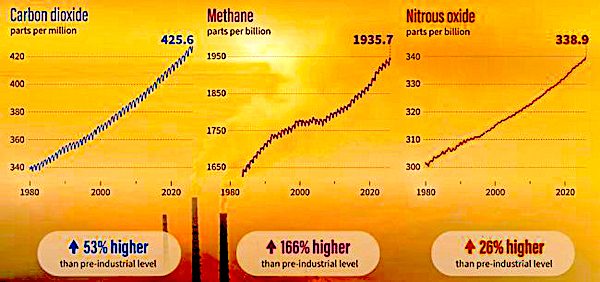
STATE OF THE CLIMATE REPORT:Emissions, sea level and ocean heat reach record highs In 2025, all 3 dominant greenhouse gases hit record highsThe 36th annual State of the Climate report says that greenhouse gas concentrations, global sea level, and ocean heat content all reached record highs in 2025
George Monbiot: Don’t despair about what’s happening to our planet. That’s what they want you to feel There are social tipping points when the seemingly impossible suddenly becomes inevitable. Good journalism plays an essential role in helping drive these shifts and shows us how real change can happen There are many reasons to despair: our green and pleasant land is parched and brown, reservoirs are depleted, and wildfires are racking the UK, Europe and the US. But there are many more reasons not to despair: despair is self-fulfilling; despair is disempowering; despair is what the bastards want you to feel. But above all, despair is irrational. Let me explain why. However sophisticated our forecasting tools may be, we simply have no means of knowing what comes next. Like the climate, like every ecosystem, society is a complex system. Its properties and adaptive responses cannot be predicted by studying its components in isolation, regardless of the brilliance of social scientists and futurologists. Things happen — unexpected things — sometimes at astonishing speed. In other words, society has tipping points. It can quickly flip from one equilibrium state to another. … The greatest question we confront, possibly the greatest question humanity has ever confronted, is whether we can hit the social tipping points before we hit the environmental tipping points.
July was hottest month ever recorded in US as heatwaves scorched country. Drought, water rationing and dry rivers: our water crisis is here
The United States Cannot Get the Lead Out!:
Basic Information about Lead in Drinking Water Jun 18, 2026 — EPA estimates that drinking water can make up 20 percent or more of a person’s total exposure to lead. Infants who consume mostly mixed formula EPA and the Centers for Disease Control and Prevention (CDC) agree that there is no known safe level of lead in a child’s blood. Taking action to reduce these exposures can improve outcomesLead is harmful to health, especially for children. …Read more
EPA Announces $2.9 Billion for States to Reduce Lead in Drinking Water and Protect Americans’ Health I moved into a ‘Affordable Housing” Senior Luxury Apartment Bulidng. It had been recently built when I moved in. At first. there was no lead in the water. After tenyears, I noticed a change in the cold hot waters taste. So I bought lead testing sicks from a hardware store (They are also available at Amazon). I tested the hot water and it tested positive for lead, but he cold water did not. Recently the cold water had tasted fifferent. Sure enough is teat positive for lead! So now I drink Brita Lead filtered kitchen water fountain water, How did the happen? I suspect that the building used lead abated pipes in stead of lead free pipes. After a while the abateed pipe line wear down. Which explains why the cold water took long to test positve lead.
The Poisoning of Children & The Arrogance of WealthNew York City Focuses on Lead Poisoning Prevention
Janitor Says Fear Kept Her Silent Before Joining Class-Action Lawsuit Against WinCo Foods
Economist Baker Explains: AI Bubble Is About To Burst
Yale Study: Medicare for All Would Save Over 114,000 Lives and $1 Trillion a Year