
The Need for A World Ecosocialist United Front!
The Need for A World Ecosocialist United Front!
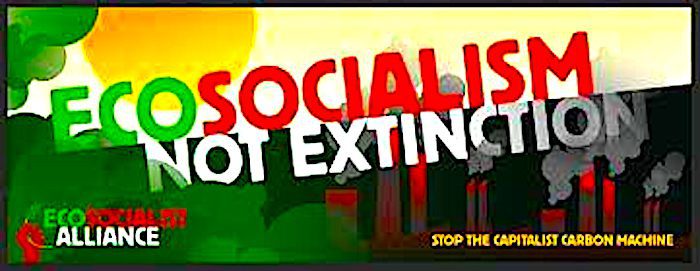
When World Envrionmmental Organizarions Publish the Extreme Heat and Agriculture A Food and Agriculture Organization (FAO); World Meteorological Organization (WMO)Joint Report concluding “Protecting the future of agriculture and ensuring global food security will require not only building on-farm resilience but also exercising international solidarity and collective political will for risk sharing, and a decisive transition away from a high-emissions future.” Where are the World’s Socialist Organizatiions? They are stting on the sidelines!
The joint statement proves that the the conditions are rotten ripe for an Eocsocist United Front!
All Climate Indicators are that we are in the dawning of the Age of Ecocide!
The Objective Situation is That The World is in An Environmnetal Global Warming Crisis!
It is time for the world socialist organizations to stop fiddleing around as the world burns!
The Ecosocialist Manifesto is is a call for action!
The Rallying Cry Should Be Ecosocialiam or Ecocide!
It time for socialists to stop fiddleing around as the world burns!
For A World Ecosocialist United Front!
(The Australian newspaper Green Leftpublished this draft Ecosocialist Manifesto on September 24. It will be discussed and further developed at conferences on Ecosocialism 2020: From rebellion to revolution, in Sydney, Perth and online, October 24-25.)
An Ecosocialist Manifesto: For an Egalitarian, Cooperative Road to Ecosocialism!
We are in the midst of a climate emergency and there is no way out without radically changing the way society is organised. If humanity does not free itself from the capitalist drive for ever greater profits and ever-expanding economic growth, rising global temperatures alone will make the planet uninhabitable for humans and millions of other living species. We urgently need to find a collective road to a new way of living that is based on human solidarity and ecological sustainability!
- The emergency is now
Catastrophic fires, extreme weather events, rising sea levels and the shocking collapse of biodiversity are a reality after just 1°C of global warming. At current rates of greenhouse gas global emissions we are heading for 2–3°C rise.
Despite numerous warnings from the world’s leading scientists, none of the global climate summits have produced the targets, let alone actions, needed to address the climate emergency.
The governments of a number of rich countries — including the United States and Australia — are defending the profit greed of the giant fossil fuel companies. They are also stubbornly resisting calls for binding and effective greenhouse gas emission cuts and for the richest countries to pay the climate debt owed to the rest of the world that they have ruthlessly exploited and oppressed for generations.
The climate emergency is just part of the historic clash between the capitalist system and nature.
Corporate greed has destroyed entire ecosystems and poisoned land and seas with toxic waste. Land clearing, driven by capitalist agribusiness, has robbed the planet of the forest cover needed to absorb carbon dioxide and provide a home for many species. It has also unleashed deadly new pandemics, such as COVID-19.
The climate emergency and the COVID-19 pandemic are symptoms of the dangerous rift that capitalism has created with nature and which it continues to exacerbate.
But the COVID-19 pandemic also shows us that the privileged ruling elites and the majority they exploit and oppress cannot carry on in the old way.
The huge death toll from COVID-19 in the US, the world’s richest and most powerful country, demonstrates that even the most privileged will not be spared the impact of the existential crisis that capitalism has created.
- We need to move beyond capitalism to ecosocialism
Just 100 fossil fuel corporations account for 71% of global greenhouse gas emissions. Leading climate activist Greta Thunberg has pointed out that the capitalist class has already contracted out a lot more than the world’s carbon budget, which the Paris Agreement said is needed to keep global warming to 1.5°C.
Attempts by the climate summits to find capitalist-friendly solutions to the climate emergency have not worked. “Market solutions”, such as carbon trading, have failed even in the few capitalist states where they have been implemented. Any “greening” of capitalism, that such market solutions may have encouraged, is too little and too late.
To pull back from catastrophic climate change requires emergency action to democratise the economy. To do this, critical industries such as energy, transport, agribusiness and the financial institutions that invest in them need to be brought under social control — now.
This will be necessary to move rapidly to 100% renewable energy and to reduce net carbon emissions to as close to zero as possible.
This all points to the urgent need to replace capitalism with an ecosocialist society, that could address gross injustices and repair capital’s rift with nature.
The corporate rich, that now rule the world, stole much of their starting capital directly or indirectly through colonial plunder. They destroyed numerous societies around the globe, many of whom were organised for thousands of years around Indigenous social values of egalitarianism, cooperation and co-existence with nature.
An ecosocialist future would require a return to such principles, with the benefit of technological advances used for social good.
Under capitalism, almost every technological advance is used to deepen the exploitation of the majority and nature, or to build dangerous weapons of mass destruction and suppression.
An ecosocialist society would liberate human creativity through translating productivity gains into a radically shorter working week. This is also necessary to free the majority of the population — now exploited to the point of exhaustion or discarded as surplus labour — to exercise direct democratic control of society.
An ecosocialist society will need to be based on grassroots direct democracy that allows communities to have real control over their destinies.
- Capitalism’s violent defence of power and privilege
The giant corporations are using all their power and privilege to defend their narrow interests — even as it becomes increasingly clear that humanity cannot carry on as before.
They buy off governments or remove any that challenge their interests. They promote and fund climate denialist, racist, misogynist and nakedly fascist movements.
They have already plunged entire nations into permanent war to protect their right to plunder and exploit the world. Now, they are even supporting violent right-wing forces in the US threatening civil war.
They are prepared to use the disproportionate military power of the US and its rich country allies to preserve a grossly unequal capitalist global division of labour and a presumed “right” to continue passing the costs of the ecological crisis on to the poorest countries.
They are resisting calls for reparations to be paid to those countries they have plundered and poisoned. They are blocking calls for rich countries to adopt sharper and deeper
- Building a movement for ecosocialist revolution
A new mass movement for ecosocialist revolution needs to be built from the radicalising climate emergency movement and other progressive mass movements, such as the Black Lives Matter Movement, that are challenging the capitalist system in the face of rising fascist movements, racism, sexism and attacks on civil liberties.
In all these movements, we hear calls to end capitalism and build a new future based on the collective and ecologically sustainable traditions that capitalism has tried its best to wipe out over the last 400 years.
Ecosocialists seek to unite and amplify those voices for real change.
History teaches us that people’s political consciousness can develop rapidly in the process of sustained collective struggle and that such movements act as schools of direct democracy. They can also give birth to new institutions of popular democracy.
Therefore, it is of critical importance to build mass movements around programs of immediate and transitional measures that the climate emergency demands.
The radical green new deal programs, championed by former British Labour leader Jeremy Corbyn, the US Green Party and US Democratic Senator Bernie Sanders, are examples for such a program.
But the system change potential of any such transitional program can only be realised by an independent mass movement that goes beyond the limits of electoral campaigns.
The deepening crisis that we are confronting today makes it clear that time is of the essence.
The time to stop capitalism from destroying our common future is running out. The need to build this mass movement for change means we urgently need to build ecosocialist organisations and global networks that can unite their impact.
Extreme Heat and Agriculture A Food and Agriculture Organization (FAO); World Meteorological Organization (WMO)Joint Report
Conclusion: The evidence presented throughout this report on the many direct and indirect impacts of extreme heat and the interconnected nature of compound events and complex compound impacts makes it clear that a business-as-usual, siloed response to the growing risk of extreme heat is insufficient. A risk analysis focused on a single crop’s response to a single hazard will inevitably underestimate the profound challenges that must be addressed to strengthen the resiliency of agrifood systems globally. The challenges of responding to extreme heat demand a transformative approach grounded in proactive adaptation, integrated governance, and ambitious climate change mitigation. As the frequency and intensity of extreme heat events continue to increase with climate change, building systemic resilience through adaptation and dedicated risk reduction is imperative. The path forward requires a shift from reactive crisis management to proactive risk reduction, beginning with the empowerment of agricultural producers by giving them access to essential information and tools. A key opportunity lies in leveraging the high predictability of heat. Agrometeorological advisories and early warning systems linked to anticipatory action protocols represent a highly promising and widely applicable adaptation measure. These systems enable farmers, pastoralists, and fisherfolk to implement tactical, on-farm responses and are a critical first line of defence. However, technical on-farm solutions alone are insufficient. Effective risk governance requires a transformative and integrated approach that moves horizontally across sectoral silos and aligns vertically from national policy to local action. Extreme heat is a systemic risk that demands coordinated systemic policy development involving ministries of agriculture, health, water, labour, disaster risk authority, and others. A primary obstacle is often fragmented institutional responsibility. Overcoming this requires high-level political commitment to establish clear mandates and coordination mechanisms, such as integrating agricultural resilience into national heat action plans, to support the diverse needs of local agricultural systems. Even with strong governance, it must be acknowledged that there are the profound barriers and limits to adaptation. The successful implementation of even proven strategies is in many contexts hindered by substantial financing gaps, weak institutional capacities, and socioeconomic barriers that disproportionately affect the most vulnerable. While many of these are ‘soft’ limits that can be overcome with resources and political will, there are also ‘hard’ physiological and ecological limits that no amount of adaptation can surmount. While this report outlines a path toward enhanced resilience, solutions and opportunities are not infinite. Alongside robust adaptation and risk reduction strategies, the only durable solution to the escalating threat of extreme heat lies in ambitious, multilateral climate change mitigation. Protecting the future of agriculture and ensuring global food security will require not only building on-farm resilience but also exercising international solidarity and collective political will for risk sharing, and a decisive transition away from a high-emissions future.