
The Resegregation of the United States
The Resegregation of the United States
Navigatatiing Back to Segregation!
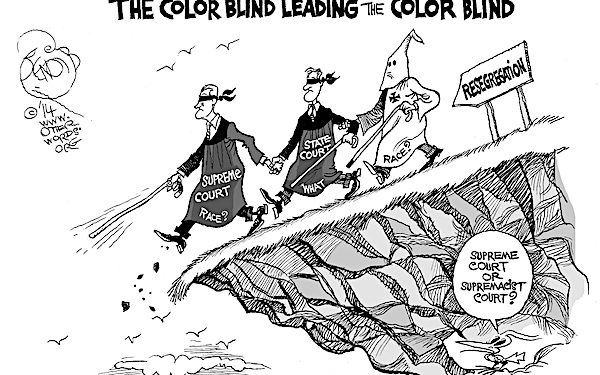
The whole process of resgregation started with the system of urban development, after the assassinations of Martin Luther King and Malcolm X. This paved the way for the Civil Rights Movement to be co-opopted by the Democratic Party. (Read my essay The Rise and Fall of the Civil Rights Movement.)
Having Black People Elected to Federal, State, and Local Officials Gave the False Illusion of Inclusion in White Society.
From Sixty Years after Brown: Resegregation in America: Even under the more liberal Obama administration, the executive branch has not developed incentives for schools to integrate. [17] Like George W. Bush, his administrative policies on racial isolation in schools are eerily silent. Educational priorities have shifted in recent decades from the “equality and justice” rhetoric of the Civil Rights era toward “standards and accountability” rhetoric stemming from the Reagan period. Interest in school integration has fallen through the cracks. The focus is instead on charter schools, which have been shown to divert funds from traditional schools and increase segregation. [18] However, whether public school integration is the best way to addressing racial discrimination and social inequality in America remains an even deeper question: social programs and community-based programs could be more effective, some contend. Moreover, if America’s approach to racial issues, i.e. targeting many policies directly at racial and ethnic groups, is the most efficient way to direct public discourse remains a question, too, versus the “color-blind” French model. Though Brown’s legacy is seemingly failed, revitalizing – or reinventing – the legacy is an American dream to pursu
The copoption by the Democratic Party and the decline started of the Cicil Right Movement with the War on Poverty Programs and Dollars spread by the goverment.
To combat the rise of the Civil Right Movement, the “war on poverty” was first launched in 1964 along with the concept of “Black Politicians”. Malcolm X described this process in his Jan. 7, 1965 speech The Prospects for Freedom, at the Militant Labor Forum, in New York City (For complete an audio of the speech go here.):
“They have a new gimmick every year. They’re going to take one of their boys, black boys, and put him in the cabinet so he can walk around Washington with a cigar. Fire on one end and fool on the other end. And because his immediate personal problem will have been solved he will be the one to tell our people: ‘Look how much progress we’re making. I’m in Washington, D.C., I can have tea in the White House. I’m your spokesman, I’m your leader.’ While our people are still living in Harlem in the slums. Still receiving the worst form of education. But how many sitting here right now feel that they could [laughs] truly identify with a struggle that was designed to eliminate the basic causes that create the conditions that exist? Not very many. They can jive, but when it comes to identifying yourself with a struggle that is not endorsed by the power structure, that is not acceptable, that the ground rules are not laid down by the society in which you live, in which you are struggling against, you can’t identify with that, you step back. It’s easy to become a satellite today without even realizing it. This country can seduce God. Yes, it has that seductive power of economic dollarism. You can cut out colonialism, imperialism and all other kind of ism, but it’s hard for you to cut that dollarism. When they drop those dollars on you, you’ll fold though.”
After the assassination of Martin Luther King and the subsequent rebellions in the inner cities protesting his assassination, the Democratic Party’s “war on poverty” started laying dollars on any potential Black leaders and grooming Black Candidates.John Lewis, formally of SNCC, became enlightened, he ignored the Black Panthers and saw the Democratic Party, symbolized by a jackass, as his party. Most of what W.E. B. Dubois described as the “talented tenth” were bought off by this process. The more radical concepts that Martin Luther King and Malcolm X had developed at the time of their deaths disappeared from the scene. No one took up where they left off. The governmental policy, directed towards the ‘leaders’ of the civil rights movement, of the carrot (dollarism) and the stick (assassinations) had proven to be successful.Unlike Malcolm X, whose assassination cut short his organizing plans, King was organizing a movement to obtain his stated goals when he was assassinated.
In fact, he was in Memphis to build that “coalition of an energized section of labor, Negroes, unemployed, and welfare recipients” in support of striking municipal sanitation workers.
If such a force had been launched, the whole power of the antiwar and civil rights movement in the 1960s could have transformed the labor movement and become “the source of power that reshapes economic relationships and ushers in a breakthrough to a new level of social reform.”
Civil Rights Struggle for the 21st Century
Unlike Malcolm X, who never got the opportunity to act upon his convictions, Martin Luther King was organizing a movement to obtain his stated goals when he was assassinated in Memphis. He was in Memphis to build “the coalition of an energized section of labor, Negroes, unemployed, and welfare recipients” in support of strikingmunicipal garbage workers. If such a force had been launched, the whole power of the antiwar and civil rights movement in the 1960s could have transformed the labor movement and become “the source of power that reshapes economic relationships and ushers in a breakthrough to a new level of social reform.” Such a coalition, as King envisioned it thirty-three years ago, is needed today.
The best tribute to Martin Luther King and Malcolm X would be to begin anew to build a movement based on the ideas and the concepts that they had developed at the time of their untimely deaths.
Unfortunately, the civil rights movement, after Martin Luther King and Malcolm X, subordinated independent mass struggle in the streets to electoral activity: to elect Democrats. Black Democratic politicians under the slogan: “vote for me and I’ll set you free,” began distributing “war on poverty” money to Black organizations. What W.E.B. DuBois called the “talented tenth” got government jobs and became comfortable. This whole process demobilized the civil rights movement of the Black masses, who were subsequently left behind.
Today, the bankruptcy of this policy has come home to roost upon all workers as pensions, wages, our standard of living, etc., are under attack and devalued by inflation. Blacks and other minorities especially have faced the brunt of these attacks. They are disproportionately among the ranks of the unemployed and the underemployed. On the question of civil rights, conditions have reverted to the 60s for the Black masses and for Latinos. According to the Harvard Civil Rights Project, www.civilrightsproject.harvard.edu/ the nation’s schools have become re-segregated along Black, Latino, and economic lines. Throughout this country, the inner cities are being gentrified as Blacks and the poor are forced out and scattered throughout the land. The action in response to Hurricane Katrina and the explosion of the immigrant rights movement; a reflection of the rise of the indigenous people of all of Latin America for their rights, bring hope for a better future and are just a hint of what’s to come. As we make a balance sheet of the Civil Right’s Movement against the backdrop of the world and domestic situation at the opening of the 21st century, clearly Martin Luther King Jr.’s “Dream” is not possible under the “Nightmare” of capitalism. The modern-day tyranny of the multinationals and their beholden representatives in government is based on dividing working people worldwide on the basis of race, nationality, and gender. There is no way forward for Black and Latino workers, or even for their white counterparts, under capitalism. The system of capitalism is based on the exploitation of Labor, and one of the foremost methods of capitalist exploitation of Labor is the weapon of racism, how can any lasting solution to this problem of humanity be achieved under capitalism? As Malcolm X said: “… Racism is profitable if it wasn’t profitable it wouldn’t exist.
At Frogmore, S.C. November 14, 1966, King echoed Malcolm X when he said in a speech in front of his staff. “You can’t talk about solving the economic problem of the Negro without talking about billions of dollars. You can’t talk about ending the slums without first saying profit must be taken out of slums. You’re really tampering and getting on dangerous ground because you are messing with folk then. You are messing with captains of industry…. Now this means that we are treading in difficult water because it really means that we are saying that something is wrong… with capitalism… There must be a better distribution of wealth and maybe America must move toward a democratic socialism.”
The only permanent solution to the exploitation and oppression of African-Americans is Socialism, based on the multi-racial working class becoming the masters of their own society, culture, and economy. Only on this basis can the age-old double exploitation of Blacks be eliminated and replaced by a society fit for all human beings to live in. Only on this basis can the African-American working-class take its rightful place as masters of the country that was built by the blood and sweat of its slavery: both the chattel slavery of the plantation and the wage slavery of the city. The lesson of this history is that if we keep our politics independent of the Republican and Democratic Parties and the government; if we rely upon our own power in the streets; if we take up the struggle where Malcolm X and Martin Luther King, Jr. left off, we will win.
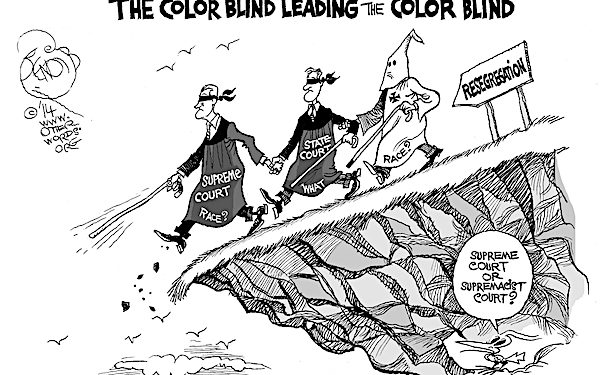
NAVIGATING BACK TO SEGREGATION
Appendix:
According to the Harvard Civil Rights Project, which recently was forced to move to UCLA, the public schools have become more separate and unequal— the consequences of the last two decades of resegregation along economic, ethnic and racist lines. 11 Throughout this land, both the Republican and Democratic Parties are gentrifying the inner cities, in the service of big business, and the poor are being scattered to the winds. It is how the rich are handling unemployment and poverty in this country. Recently, Black U.S. Senator Barack Obama (D-IL) went to Africa to publicize the catastrophe of Aids in Africa. He should have also gone to the Black Communities in the United States and publicized the crisis of Aids in Black America, where nearly half of the million Americans, who are living with HIV today, are Black. In fact it has become a Black disease. 12 The bipartisan corporate “bankruptcy reforms” in the late 80s to the present have allowed corporations to lay off workers, rob pension plans, and tear up union contracts. Because Black workers are still the “last hired and first fired”, they have received the brunt of these attacks. Overall, the rich have become richer, and the poor have become poorer. Ben H. Bagdikian put it well in his “Preface to the Sixth Edition” of the The Media Monopoly, after he explained that just six of the world’s largest corporations, control 95% of the mass media, he wrote: “The American economy [has been] undergoing an astonishing phenomenon that the mainstream news left largely unreported or actually glamorized in its infrequent references, the largest transfer of the national wealth in American history from a majority of the population to a small percentage of the country’s wealthiest families.” 13 This process was facilitated by the fact that almost every “tax reform” from Kennedy in 1961, to Bush in 2004, has resulted in the taking of wealth from the working class and giving it to the capitalist class. And yet, the Congressional Black Caucus echoes the “hype” from the government, the press, and the Republican and Democratic Parties, that things are better today. The economic figures from the bipartisan wage-price freeze in 1972 to today demonstrate that this it is false illusion. he Congressional Black Caucus echoes the “hype” from the government, the press, and the Republican and Democratic Parties, that things are better today. And yet, racism continues to be an institutional part of the United States. — The Rise and Fall of the Civil Rights Movement
The Supreme Court struck down two voluntary desegregation plans with a majority of the Justices holding that individual students may not be assigned or denied a school assignment on the basis of race in voluntary plans even if the intent is to achieve integrated schools—and despite the fact that the locally designed plans actually fostered integration. A majority of the Justices, on a Court that divided 4-4-1 on the major issues, also held that there are compelling reasons for school districts to seek integrated schools and that some other limited techniques such as choosing where to build schools are permissible. In the process, the Court reversed nearly four decades of decisions and regulations which had permitted and even required that race be taken into account because of the earlier failure of desegregation plans that did not do that. The decision also called into question magnet and transfer plans affecting thousands of American schools and many districts. In reaching its conclusion the Court’s majority left school districts with the responsibility to develop other plans or abandon their efforts to maintain integrated schools. The Court’s decision rejected the conclusions of several major social science briefs submitted by researchers and professional associations which reported that such policies would foster increased segregation in schools that were systematically unequal and undermine educational opportunities for both minority and white students. The Court’s basic conclusion, that it was unconstitutional to take race into account in order to end segregation represented a dramatic reversal of the rulings of the civil rights era which held that race must be taken into account to the extent necessary to end racial separation. The trends shown in this report are those of increasing isolation and profound inequality. The consequences become larger each year because of the growing number and percentage of nonwhite and impoverished students and the dramatic relationships between educational attainment and economic success in a globalized economy. Almost nine-tenths of American students were counted as white in the early l960s, but the number of white students fell 20 percent from l968 to 2005, as the baby boom gave way to the baby bust for white families, while the number of blacks increased 33 percent and the number of Latinos soared 380 percent amid surging immigration of a young population with high birth rates. The country’s rapidly growing population of Latino and black students is more segregated than they have been since the l960s and we are going backward faster in the areas where integration was most far-reaching. Under the new decision, local and state educators have far less freedom to foster integration than they have had for the last four decades. The Supreme Court’s 2007 decision has sharply limited local control in this arena, which makes it likely that segregation will further increase. — Historic Reversals, Accelerating Resegregation, and the Need for New Integration Strategies
Julia also asked us to realize that the racist and sexist system we live in does not want us to be together in love and struggle. “We have a system that would not like to see Black males and females coming together,” she tells us. For oppressors understand the power of our coming together, the power of both Black men and women and our capacity to break their hold on our lives. In a word, she says, “They understand that if our relationships are together, they lose,” we win and the world benefits. But if we aren’t together, we can’t build and sustain good lives, resist our oppression and will succumb to promises of social integration which she defines as “the illusion of inclusion,” far different than shared wealth, power and status. — Raising Dr. Julia Hare: Her Honored Life and Unforgettable Love
Despite decades of progress since Brown v. Board of Education, racial segregation in American public schools remains a persistent reality. In many districts, Black and Hispanic students are concentrated in schools where the majority of their peers are students of color. Because resources, opportunities, and access to advanced coursework remain unevenly distributed, these schools often limit access to qualified teachers, college preparation, and other critical supports, directly affecting students’ long-term academic and professional outcomes. Segregated schooling is not just a reflection of residential patterns driven by private choices, but is also the result of policy choices that continue to shape where children attend school. Achieving meaningful desegregation requires more than simply removing explicit legal barriers. It involves addressing not only de jure segregation, which is imposed by law or policy, but also de facto segregation, which arises from social and economic barriers, such as exclusionary housing policies and local school enrollment practices. Despite ongoing resistance and renewed attacks by the current federal administration, desegregation efforts remain vital to ensuring that all students have access to equal educational opportunity. — IT’S 2026. WHY ARE SCHOOLS STILL SEGREGATED?