
Daily News 10/28
Daily News 10/28
Daily News Archives Since June 2026
Capitaism Cannot Meet the Emissions Cuts to Prevent Ecocide — The Only Solution is Ecosociaist Revolution!
As temperatures spike, this new report outlines humanity’s options for containing climate change To return to 1.5°C of warming by 2100, the world will need to cut greenhouse gas emissions by nearly 70 percent within the next decade-and-a-half
Emissions Gap Report 2026: The Point of Return
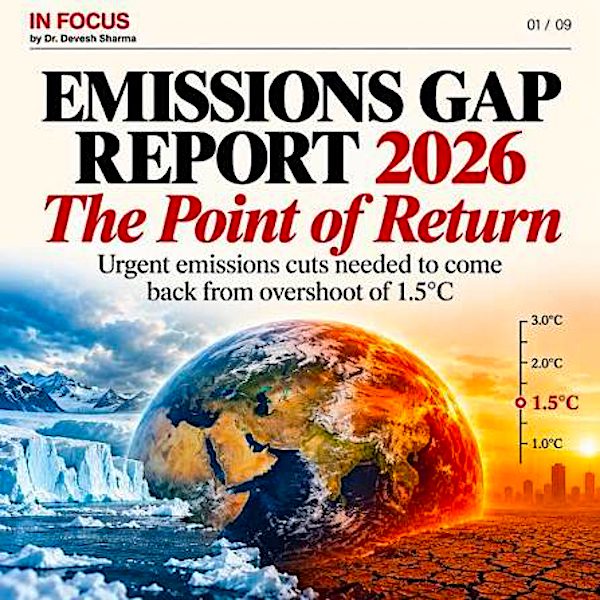
The Emissions Gap Report 2026: The Point of Return looks at a ‘lowest possible’ 1.5°C overshoot scenario, in which peak warming by around the middle of the century is limited to 1.7-1.8°C and global temperature rise is returned to or below 1.5°C by 2100, with about a 50 per cent chance. To get onto this pathway, global greenhouse gas (GHG) emissions would have to be reduced by 18 per cent by 2030, 45 per cent by 2035 and 69 per cent by 2040, all relative to 2025 levels. By contrast, the full implementation of Nationally Determined Contributions (NDCs) would only reduce emissions by 5-8 per cent by 2030 and 11-15 per cent by 2035, relative to 2025 levels. This implies average annual reduction rates of 5.7 per cent for 2025-2035, higher than the old Sixth Assessment Report (AR6) pathways laid out by the IPCC, which required annual reduction rates of about 5 per cent. —
The Emissions Gap Report 2026: The Point of Return looks at a ‘lowest possible’ 1.5°C overshoot scenario, in which peak warming by around the middle of the century is limited to 1.7-1.8°C and global temperature rise is returned to or below 1.5°C by 2100, with about a 50 per cent chance. To get onto this pathway, global greenhouse gas (GHG) emissions would have to be reduced by 18 per cent by 2030, 45 per cent by 2035 and 69 per cent by 2040, all relative to 2025 levels. By contrast, the full implementation of Nationally Determined Contributions (NDCs) would only reduce emissions by 5-8 per cent by 2030 and 11-15 per cent by 2035, relative to 2025 levels. This implies average annual reduction rates of 5.7 per cent for 2025-2035, higher than the old Sixth Assessment Report (AR6) pathways laid out by the IPCC, which required annual reduction rates of about 5 per cent. — The Climate Emergency
‘A Crime of Extreme Inequality’: Richest 0.1% Generate More Carbon Pollution Than Half of Humanity
And if you look at what’s happened since 1980 in America, the distribution of wealth for fifty percent of Americans has been absolutely flat. But almost all of the wealth increase has accrued to the top ten percent of the population, mainly in the finance, insurance and real estate sector and monopolies, such as information technology or natural resource monopolies like oil. So you have a completely different economic structure in China than you have in the West. And the result is that basically the objective of all this in China was to avoid the kind of debt deflation, the debt overhead that you have in the United States that’s increased the cost of living by all of the debt service that wage earners have to pay for their education debt, their credit card debt, just to break even, their automobile debt, their student loan debt, their medical debts. The debt overhead of American labor is so high that it can’t afford to compete with foreign labor. And the mortgage debt that America has has increased the price of housing so much that the price of housing prices American labor out of the market. And the same is true of Western Europe. So the debt overhead, the financialization of the Western economies has been preventing them from competing with the Asian economies, especially China, which has tried to create credit without running into debt. In America, the financial fortunes of the wealthiest ten percent find their counterpart in the debt of American families, mortgage debtors, corporations that have been driven into debt, government debt. China’s been trying to avoid that. Maybe for the rest of the [conversation], you know, what I’d like Einar to talk about is what is the character of China’s debt and what are its debt problems and are they similar to those of the West or how are they different? — Michael Hudson, The Homeowner’s Stake in Unaffordable Housing
Trump is a Carcinogen!:The Trump Administration’s Pro-Cancer Agenda Under Trump, Americans could face an extraordinary increase in exposure to cancer-causing toxics and radiation. Over the nearly two years of President Donald Trump’s second term, his administration has taken more than 500 actions that harm public health or the environment. When faced with this onslaught of harm, it can be difficult to see the strategic agenda at play. However, NRDC’s new analysis reveals that the Trump administration is executing a sweeping and long planned—but quiet—government-wide campaign to dismember major programs that are intended to prevent exposure to cancer-causing toxics and radiation. In sum, this administration has reversed course: America’s government is no longer fighting a “War on Cancer” but fighting a “War to Promote Cancer.”
Video: France Is Only the Beginning: The End of the Western Empire | Richard Wolff
Italy: Revolutionary Communists take centre stage at Bologna demonstrationsmThe mood of anger among school students and the youth in general that we have seen in France – and Spain and many other countries – has affected Italy big time. Huge protests have taken place over the last few weeks.
Middle East peace held back by US insistence that Iran is a threat, Oman’s foreign minister says
Portugal: housing movement advances under whip of repressionAfter a slow start, Portugal is catching up fast with Europe’s Red Autumn. Scattered housing protests resulted in encampments in Lisbon and Porto, initially on a smaller scale than in the neighbouring Spanish State. However, the movement went through a qualitative leap in the past week. State repression is turning a single-issue protest for housing into a social explosion.
Lula’s Win May be a Tipping Point for Latin America
Private Prison Companies Are Pouring Money Into GOP Coffers Ahead of Midterms
As the AI Bubble Threatens to Burst, We Must Prepare to Fight a Big Tech Bailout
Is universal healthcare finally becoming a vote-winning issue in US elections?
Medicare For All Can Be Simple Medicare for All could expand access to health care while reducing administrative costs and prescription drug prices. Replacing patent monopolies with public funding for medical research could further lower costs and improve access to treatments. With soaring health care costs and a plunge in coverage rates, there is growing interest in Medicare for All. Polls show that a large majority of the public now favors a universal Medicare system, with even a substantial share of Republicans now backing it. A universal Medicare system has a huge amount to recommend it. Of course, the main point is to ensure that people can get the health care that they need, but it also eliminates a vast amount of waste in the national health care system. In addition to the $300 billion a year that we spend directly on operating the nation’s health insurance system, another $1.6 trillion is spent on administrative costs running our health care system by providers like hospitals and doctors’ offices, according to analysis by David Himmelstein, Terry Campbell, and Steffie Woolhandler. These additional costs are all the office personnel and various navigators involved in assisting patients in dealing with insurers. They found that in the United States we spend roughly 31 percent of each dollar in health care spending on administrative costs, whereas under Canada’s universal Medicare system, the cost is just 16 percent of spending.
The housing question under socialismA century and a half after Friedrich Engels explored the housing question, full socialization remains its best answer. In 1872, the German socialist newspaper Der Volksstaat ran a series of articles on housing. The breakneck growth of industrial cities had brought overcrowding, squalor, and soaring rents for workers. Their author, Arthur Mülberger, drawing on the ideas of the French anarchist Pierre-Joseph Proudhon, offered a simple solution — tenants should become owners. In the scheme, rental payments would be transformed into something like a mortgage payment. Eventually, every worker would hold the title to their own home.