
Daily News 10/02
Daily News 10/02
Daily News Archives Since June 2026
Video: Demystifying This Year’s “Super” El Niño & What it Means for UsThis year’s El Niño is intensifying at breakneck speeds, and has already broken the all-time record for daily strength — two months ahead of the previous peak set back in 2015. With weeks of additional warming in the Pacific still to come, this historic event is set to bring huge impacts to every corner of the world.will likely become the strongest event in recorded history before November. Across every corner of the planet, communities are preparing for its growing impacts this winter — but what exactly is expected? And why is so much attention being given to its “super” status? In this special conversation hosted by Covering Climate Now and Climate Central, journalists heard from other reporters, meteorologists, reporters, and international experts about what science tells us about this historic event and how to frame its possible impacts without losing sight of the role climate change plays in influencing extreme weather and temperatures.
Video: The world economy faces perfect stormThis week the interest rate on 10-year US government bonds hit 5.3 per cent, and borrowing costs in Britain, France, Germany and Japan are at levels not seen in decades. For ordinary people, that means higher costs at the petrol station, on their energy bills, in their rent and mortgage payments, and public services being cut to balance the books.
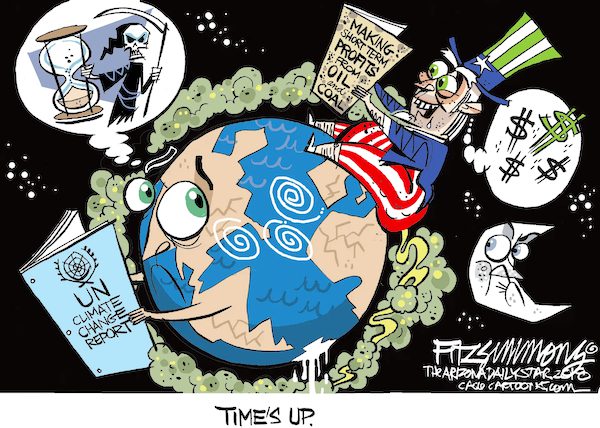
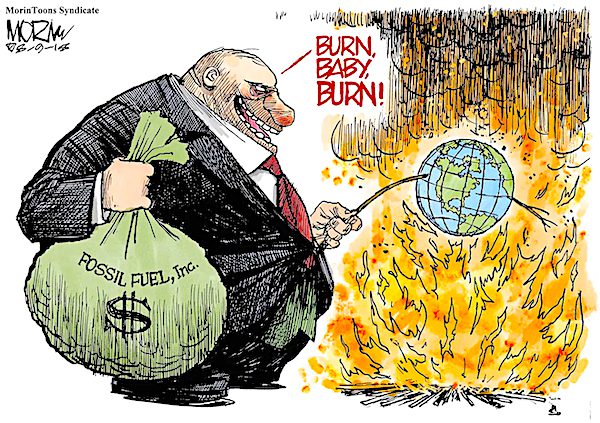
The Fossil Fuel Industry is Guilty of Depraved Infifference Ecocide! Climate Change? The Oil Industry Knew!For Over 50 Years, the Oil Industry Knew the Connection Between Burning Fossil Fuels and Climate Change.: Defense, Denial, and Disinformation: Uncovering the Oil Industry’s Early Knowledge of Climate Change As early as 1959, oil industry executives understood the connection between burning fossil fuels and climate change. Soon thereafter, industry scientists confirmed beyond a reasonable doubt that the burning of fossil fuels contributed to anthropogenic climate change. In response, oil companies scrambled to promulgate climate change denial and disinformation in order to avoid government regulation. It was not until the late 1990s and early 2000s that oil companies began publicly acknowledging the scientific consensus on climate change and responded by promoting market-based solutions to mitigating emissions. Did they inform the public about the danger! As the World Warmed, rhey just went on producing their hazardous product! To them profits were more important than life! Their ecocidal decision is a criminal act against humanity and all life on the planet! ‘Law and Order’ capitalism protects them! A Sane Society World Hold the Oil Companies Accountable for Their Crimes!
Alarm Grows Over ‘Clearly Illegal’ Trump-Rubio Election Meddling in Brazil
When War Crimes Become Normal: The Price of ImpunityIf we truly believe that all human life has equal value, then we must demand that those who order and carry out attacks on civilians face the same scrutiny and consequences, whoever they are.
Trump Administration Plans to Add 5,000 New ICE Employees by End of Year
Trump Rollback of Fuel Economy Standards Will Deal Blows to Climate and Health “There’s nothing Trump won’t sacrifice on the altar of fealty to Big Oil and auto polluters,” said one critic.
UN General Assembly adopts declaration on sea level rise The United Nations General Assembly has adopted a landmark declaration on sea-level rise, saying that “its cumulative, severe and irreversible risks demand stronger international cooperation and urgent, coordinated action.”
The Guardian view on a supersized El Niño: a natural phenomenon and human folly are a lethal combinationHundreds of thousands are expected to die, millions to go hungry. This is not just about weather patterns, but about injustice Some warnings are so grave that it is almost impossible to fully comprehend them. The descriptions of a super-sized, “Godzilla-level” El Niño already heating our planet would sound hyperbolic were they not issuing from eminent scientists. They say that the weather pattern, which occurs roughly every two to seven years, may be the strongest in at least a millennium. With its peak yet to come, the temperature rise in the Pacific Ocean has already surpassed the previous high. The consequence will be huge amounts of heat in an atmosphere already experiencing frighteningly higher temperatures due to the human-caused climate crisis. Next year is almost certain to be the hottest on record globally, breaking this year’s record. The World Food Programme has warned that 50 million people are likely to be pushed into acute hunger. Others estimate that the extra heat from El Niño alone will cause the deaths of 450,000 people by February, from Nigeria and Indonesia to the US. That extraordinary toll is in addition to those killed by the wildfires, droughts and floods it is likely to bring – and also to deaths caused by global heating.
NEW COLORADO RIVER RULES START TODAY, BUT QUESTIONS LINGER ABOUT ARIZONA WATER CUTBACKS New rules for the Colorado River officially go into effect on Thursday, but they won’t bring changes to Arizona’s water quite yet. … Federal rules for the Colorado River and its major reservoirs typically run on a different calendar than the rest of the world. … So, starting Thursday, a controversial federal plan will start changing the amount of water sent from Lake Powell downstream to Lake Mead. However, the amount of water delivered from Lake Mead to people farther downstream — like cities in the Phoenix area and huge farm districts in California — is managed in line with the normal calendar, from Jan. 1 to Jan. 1. So even though the amount of water flowing into Lake Mead will be different this week, the amount of water flowing out of it won’t change until the beginning of 2027.
The Colorado River is shrinking. What happens next?Lake Mead is at its lowest level since it was filled nearly 90 years ago, Lake Powell also at a historic low It was 42C (108F) degrees as we motored across Nevada’s Lake Mead in our rented pontoon boat. Colby Pellegrino with the Southern Nevada Water Authority wanted to show us something we shouldn’t have been able to see. She pointed toward a rock island where a large metal pipe was sticking out of the water. “That is the first intake that was built to bring municipal water into the valley in 1970,” Pellegrino said. It is part of the system that takes water from Lake Mead and brings it to Las Vegas. It was designed to sit deep underwater.“It is no longer part of how we get water to Las Vegas because the lake has dropped too much for this piece of infrastructure to be operable,” Pellegrino told us.
ITU and WMO call to protect radio spectrum for weather, climate and water services
Antarctica’s ice loss is locked in, and extra snowfall won’t save it – that’s bad news for low-lying coastal areas elsewhere In a new study published in the scientific journal Nature Geoscience, welooked at hundreds of thousands of potential futures and the impact of each on the ice sheet. We found that Antarctica’s ice loss this century is locked in – even if the world limits global warming to 1.5 degrees Celsius (2.7 degrees Fahrenheit), the 2015 international Paris climate agreement’s most ambitious goal.
The United States Desperately Needs a Care Package The care that families provide—raising children, supporting elderly parents, tending to those who cannot fully care for themselves—is among the most economically productive work in any society.
How Much Is Trump’s Senseless Iran War Costing You Personally? To be clear, this isn’t the cost of the weapons and soldiers fighting the war, which the Pentagon estimates to be around $44 billion. This is the higher cost you’re paying to fill up your gas tank and to buy products that cost more to move.
Is Trump to blame for Americans getting explosive diarrhea?As the midterms approach, Americans’ digestive health has become a bizarre talking point … I regret to inform you that the president is once again responsible for a national conversation about toilets. In a fitting encapsulation of Trumpism, explosive diarrhea has become a midterm talking point. Food recalls and stomach-churning parasites have been a mainstay of the news this year and Democrats are milking the issue. In August, for example, the Democratic party’s official Twitter/X account highlighted the number of foods that have been recalled in 2026 and demanded that RFK Jr resign from his role as health secretary. Last month (which happened to be Food Safety Month – who knew?), the Rhode Island congressman Gabe Amo argued that Trump’s cuts to the federal workforce had contributed to decreased food safety. Senator Elizabeth Warren similarly accused “slashed food safety agencies” of contributing to the “cyclospora outbreak” and demanded Trump be held accountable in November.
France: an explosive situation Since the beginning of September, social tensions have been rising day by day. As we write, tens of thousands of high school students across the country are taking to the streets to demand decent learning conditions. The government is responding with insults and police repression

Sent ot Me By Email: Gene Ludwig, Chairman, Ludwig Institute for Shared Economic Prosperity (LISEP) As former U.S. President Harry S. Truman famously quipped, “It’s a recession when your neighbor loses his job; it’s a depression when you lose your own.” Humor aside, with the Great Depression barely in the rearview mirror this may have been a fairly accurate assessment of how Americans differentiated between a “bad ” and a “very, very bad” economy. Indeed, in the days of presidents Roosevelt and Truman, life looked good if you had a job—but in most cases that meant a decent-paying, full-time position. Today, though, this relationship is much more nuanced.
Times change, and economies evolve, yet the publicly-announced metrics used to assess the nation’s economic strength have not changed substantively since the days when President Truman occupied the West Wing. Consider employment. In the decades following the Great Depression—when Americans had spent years hopeful for any job, no matter how meager—simply having a job itself was a meaningful measure of economic well-being. As the post-war economy expanded, it brought with it the expectation that a full-time job in the factories, shipyards, mines, and across retail and distribution networks should bring stability and, for many, could be a “job for life.”
Today, employment alone tells us much less about a worker’s economic well-being. We know a full-time, stable position is not always a guarantee for economic security, and anecdotal evidence nationwide bears this out. Yet many of the headline measures we use to judge the labor market still focus on whether someone is working, not on what that work provides. And so the question remains: Beyond simply having a job, are American workers earning the wages and finding the stability they need to achieve economic security?
Using the government’s frame of reference in Truman’s time, the current headline unemployment rate—4.1%, as reported by the U.S. Bureau of Labor Statistics (BLS)—looks pretty good, particularly when one considers the jobless rate hit 25% during the height of the Great Depression. Coincidentally, the BLS unemployment rate in 1946 also hovered around 4.1% on the leading edge of the economic boom following World War II. Yet I don’t think anyone would confuse today’s economy with the go-go years that followed the Second World War. The difference? Many of the jobs Americans hold today bear little resemblance to the full-time, stable jobs workers came to expect in the post-war era, when low- and middle-income (LMI) households also commanded a much larger share of national income than they do today. It’s not comparing apples to oranges; it’s comparing apples to a suspension bridge.
LISEP’s numbers tell us that the economic situation for LMI Americans is, by far, more precarious than headline statistics would suggest—a situation some have characterized as “hanging on by their fingernails.” In fact, this research found that LMI Americans have experienced long-term economic stagnation for more than two decades. In my view, for many Americans that stagnation amounts to a real economic decline as inflation has eaten away at more slowly rising wages. LISEP research also suggests that the bottom 60% of Americans, as a group, do not command enough of the nation’s income to achieve a minimal quality of life—at a time when GDP is on the rise, and upper-income Americans have generally seen stronger and stronger economic gains.
This is reflected in LISEP’s August True Rate of Unemployment (TRU) report—a measure of the functionally unemployed, defined as the jobless, involuntarily part-time, and those earning less than $26,000 annually in 2025 dollars—which came in at 24.3%. While this is a slight improvement from the elevated levels we have seen over the past few months, the number itself underscores the problem: There is a dramatic mismatch between what our traditional employment measures portray and the reality of the jobs millions of Americans actually hold.
For the “hanging on by their fingernails” workers, being employed might mean working far fewer hours than they’d like, or for poverty-level wages. This makes them particularly vulnerable to a variety of economic shocks, including higher energy prices, rising healthcare expenses, or the rising cost of housing. For those already spending most of what they earn on the bare essentials, there is very little cushion when one of those costs rises.
Hard work and personal drive have always been central to the American Dream, but they are not enough without a fair shot at real opportunity and the chance to earn a decent living.