
Daily News 08/12
Daily News 08/12
Daily News Archives Since June 2026
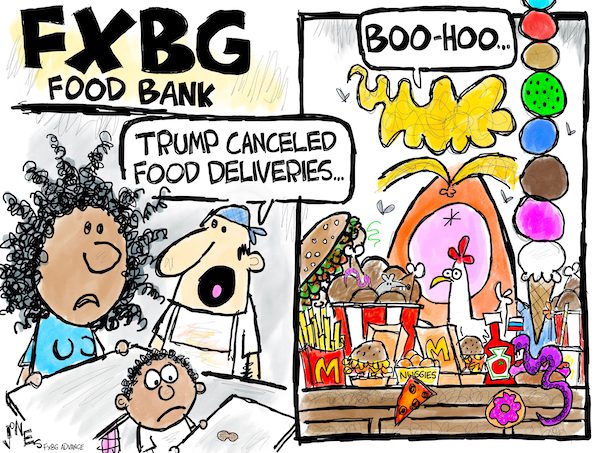
Food insecurity and hunger in the United States of America affects millions of Americans, including some who are middle class, or who are in households where all adults are in work. The United States produces far more food than it needs for domestic consumption; however, hunger within the U.S. is primarily caused by some Americans having insufficient money to buy food for themselves or their families. Additional causes of hunger and food insecurity include neighborhood deprivation and agricultural policy.[1][2] Hunger is addressed by a mix of public and private food aid provision. Public interventions include changes to agricultural policy, the construction of supermarkets in underserved neighborhoods, investment in transportation infrastructure, and the development of community gardens.[3][4][5][6] Private aid can be provided through examples such as food pantries, soup kitchens, food banks, and food rescue organizations.[7][8][— Food Insecurity and Hunger in the United States
The Facts About Hunger in America Everyone deserves healthy food to live a full, healthy life. Yet millions of hardworking families still face hunger—and when people don’t have enough to eat, it impacts their health, education and future opportunities. These numbers reveal a crisis that threatens us all, but together, we can end it.
- 48 Million People Face food insecurity—experiencing daily challenges with hunger and its health and social impacts.
- 1 in 5 Children14 million kids don’t have enough food to grow up strong.
- 50+ Million Over 50 million turned to food banks and pantries for help.
‘He Has No Choice. He Lost’: Expert Delivers Brutal Obituary for Trump’s Failed Iran War“This is a devastating defeat for the United States,” said University of Chicago political scientist John Mearsheimer
Human rights groups sue Trump administration over ‘crippling’ ICC sanctions
US War on Iran Is Devastating for Women Who Want Life and Freedom Iranian feminists asked for international help — but the U.S.-Israeli war has killed women, left many jobless and given the government a pretext to violate their rights.
A Strait of Hormuz Fee Is the Price of Trump’s Dumb, Illegal WarThe Trump administration may not like paying for the privilege of using the strait, but its decision to go to war in the first place created the situation the United States is now in. Bad policies have unintended consequences.
Iran’s Foreign Ministry stated that the region has reached a point where it is no longer just hosting U.S. military bases, but that some neighboring countries have effectively become U.S. military bases themselves. — Qora
America’s oil reserves are the lowest in 43 years America’s stockpile of crude oil has dropped to the lowest level in more than four decades. According to the US Department of Energy, the US Strategic Petroleum Reserve declined by 6 million barrels last week to 298.7 million. Data from the Energy Information Administration shows that’s the first time the stockpile has dipped below 300 million barrels since 1983. The US began the year with around 415 million barrels in the reserve, but that’s come down as the Trump administration has released more crude into the market to offset disruptions from the Iran war.
Economist Baker Explains: AI Bubble Is About To BursEconomist Dean Baker (Center for Economic and Policy Research, author of Rigged and creator of the AI Bubble Monitor) joins Taya Graham and Stephen Janis to break down why the productivity data doesn’t match the hype, why Palantir’s CEO seemed to be panicking on live TV, why Bernie Sanders’ AI sovereign wealth fund idea might backfire, and what signs to watch for if this bubble bursts.
2026 could turn out to be the hottest year on record. Yet, climate change is now on the back burner while the Trump administration intensifies its all-out assault on climate and environmental actions, as indicated by the president’s attack on the National Academies of Sciences, Engineering, and Medicine for publishing what he called “fraudulent, biased, and misleading” material on climate change. Still, even the UN General Assembly recognizes that “a clean, healthy and sustainable environment” is a basic human right and this right must be defended. — Forget Climate Doomerism. We Know What We Must Do to Protect the Planet.
AI’s potential climate benefits outweighed by role in boosting fossil fuels, study finds
Woods Hole Oceanographic Institution | WHOI: El Niño El Niño is a warming of surface waters in the eastern tropical Pacific Ocean, while La Niña is a cooling event. What is El Niño? The Pacific Ocean drives the El Niño-Southern Oscillation (ENSO), which has three states: El Niño (a positive or warm state), La Niña (negative or cool), and a neutral state. ENSO is a naturally occurring cycle that involves temperature changes in the Pacific Ocean and the resulting atmospheric responses to seawater as it warms and cools. It involves feedback loops in which the ocean alters atmospheric systems, which in turn affect the ocean. Although it occurs repeatedly every two to seven years, ENSO does not have a regular, predictable rhythm. As the largest ocean on Earth, the Pacific receives vast amounts of sunlight. Its waters absorb and store the sun’s heat, which warms the ocean to a depth of about 200 meters (650 feet). Earth’s rotation creates easterly winds that blow from east to west across the equatorial Pacific. During neutral ENSO conditions, these trade winds force warm surface water westward, piling it up near Indonesia. This movement thins the layer of warm surface waters off the coast of Ecuador and Peru, allowing cold waters from the depths to well up. The resulting east-west temperature differential drives large-scale weather patterns: warm air rises near Indonesia, which leads to low atmospheric pressure, persistent storms, and abundant rainfall. As the air rises, it flows eastward, eventually sinking again in the eastern Pacific. The rising air masses draw air from surrounding areas. This helps maintain the trade winds near the ocean’s surface and completes the atmospheric circulation pattern known as Walker Circulation. During an El Niño event, heat stored in the central Pacific builds up. It warms the overlying air mass, creating a broad area of low pressure. Because the location of the low-pressure system is in the middle of the ocean, it weakens the trade winds. No longer pushed westward, warm surface waters slide east, and storm systems move with it. This change in airflow alters rainfall across the Pacific basin and beyond, leading to flooding in some areas and drought in others.