
Daily News 06/26
Daily News 06/26
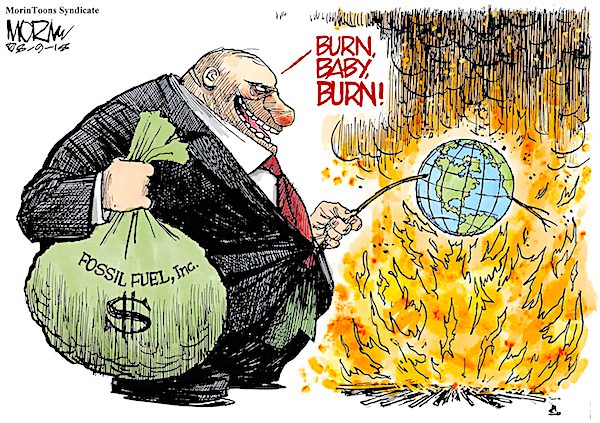
Global Warming: Summer has Just Begun, and Already There is a Global Heatwave! And Yet, Big Oil is Still in Denial of It’s Own Science! Climate Change? The Oil Industry Knew! For Over 50 Years, the Oil Industry Knew the Connection Between Burning Fossil Fuels and Climate Change.: Defense, Denial, and Disinformation: Uncovering the Oil Industry’s Early Knowledge of Climate ChangeAs early as 1959, oil industry executives understood the connection between burning fossil fuels and climate change. Soon thereafter, industry scientists confirmed beyond a reasonable doubt that the burning of fossil fuels contributed to anthropogenic climate change. In response, oil companies scrambled to promulgate climate change denial and disinformation in order to avoid government regulation. It was not until the late 1990s and early 2000s that oil companies began publicly acknowledging the scientific consensus on climate change and responded by promoting market-based solutions to mitigating emissions. Did they inform the public about the danger! As the World Warmed, rhey just went on producing their hazardous product! To them profits were more important than life! Their ecocidal decision is a criminal act against humanity and all life on the planet! ‘Law and Order’ capitalism protects them! A Sane Society World Hold the Oil Companies Accountable for Their Crimes!
Heatwaves and the Scorching Summer of 2026: Why the World Is Feeling the Heat
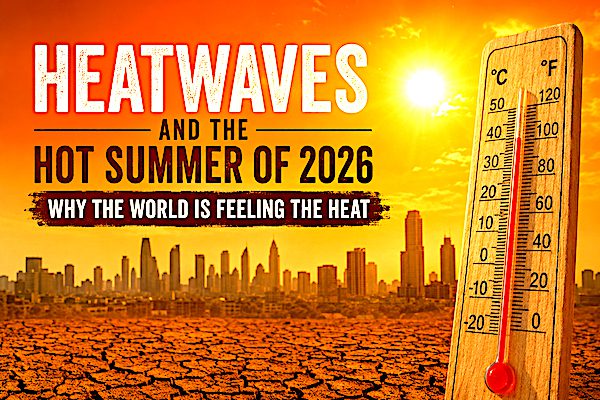
The World’s Heatwaves are a Global Health Emergency! How many heat deaths and system failures will governments accept as normal? Heat is no longer a future climate risk. It is already here. Across continents, high temperatures are being pushed higher by forces acting at once: human-caused warming, very warm oceans, dry soils, slow-moving high-pressure weather systems and El Niño conditions that have now developed in the tropical Pacific. El Niño is a natural warming of part of the tropical Pacific that can shift weather patterns around the world. It is not the cause of climate change, but when it develops in a climate already warmed by greenhouse gas pollution, it can add another push to global temperatures and regional extremes. The science is clear. Greenhouse gases have raised the baseline, so heatwaves now begin from a warmer starting point. Record ocean heat adds more energy to the climate system. Dry ground can intensify heat, because less of the sun’s energy goes into evaporating water from soil and plants, and more goes into heating the air.… Inequality and infrastructure Personal precautions save lives, but they cannot make unsafe housing safe, cool a badly ventilated care home or protect outdoor workers without changes to working conditions. Heat risk is shaped by inequality. People without trees, insulation, ventilation, secure work, clean water or affordable energy are less able to avoid exposure, cool their homes or recover after extreme heat. The same pattern applies between countries: communities that have contributed least to climate change are often disproportionately affected, because they have fewer resources for adaptation, healthcare, infrastructure and disaster response. Adapting to heat has to be collective: cooler housing, shaded streets, heat-resilient hospitals, reliable water systems, worker protections, public cooling spaces and early warning systems that reach the people who need them. Heat and drought are increasingly linked emergencies. Heat increases demand for water and electricity. Drought can reduce supply. Together, they can create failures across health, transport, food, water and energy. Water, health, energy and climate planning need to be connected, because stress in one system can quickly spread to another. The next heatwave will be reported as weather. It should also be understood as a test of housing, healthcare, infrastructure and public protection. A hotter world is already here. The question now is how many heat-related deaths and system failures governments are prepared to accept as normal.
Europe heatwave live: UK breaks temperature record for June as parts of France hit 40C – as it happened (Forty C =104F) Summary
- UK broke the all-time June temperature weather, with today officially being the hottest June day since the 1967 heatwave. Surrey rang in the high first at 35.7C before Wiggonholt in West Sussex beat that 35.8C. The previous record high was 35.6C in Southampton.
- Scotland also recorded its hottest day of the year, with temperatures reaching a high of 29.4C at Dyce in Aberdeen on Tuesday. Temperatures at Fyvie Castle in Aberdeenshire hit a high of 29C on the same day and reached 28.7C at Aboyne in Aberdeenshire, Leuchars in Fife and Edinburgh.
- Mainland Spain also recorded its highest daily average temperatures in June since at least 1950, with temperatures surpassing 39C in Bilbao today. Temperatures are expected to drop in most of the country though, with only parts of the Basque country in the north still marked red.
- At least 94 million people in Europe were expected to experience temperatures above 35C today, most of them in France and Spain, AFP estimated. More than 350 million people were expected to experience temperatures above 30C.
- The head of the World Health Organization, Tedros Adhanom Ghebreyesus, warned that Europe’s heatwave is “putting people’s health are risk.” “The data are clear: temperatures across Europe are rising at roughly twice the global average rate, increasing the likelihood and severity of extreme heat in the future. We cannot afford further delay. Leaders must prioritise investment in climate-resilient health systems, while also accelerating #ClimateAction and mitigating the drivers of the climate crisis.”
Congress Is Preparing to Surrender American Sovereignty on the Eve of America’s 250th Anniversary

Democrcy?: Take Action to Defeat a Dangerous Expansion of the National Security State, Military Power Over Civilian Government, Foreign Policy Entrenchment, and the Erosion of Constitutional Self-Government Dennis Kucinich and Elizabeth Kucinich June 22, 2026 The United States Congress, on the very eve of the 250th anniversary of our Declaration of Independence from Great Britain, is preparing to formally diminish American independence and sovereignty through a proposed merger and long-term integration of executive functions throughout the government, coordinated by the Department of Defense. Treacherous provisions in the 2027 National Defense Authorization Act (NDAA) mandate that the U.S. State Department, the U.S. Commerce Department, and the heads of other relevant federal departments and agencies cooperate with their Israeli counterparts for the purpose of consolidating U.S. and Israeli military activities in order to align efforts and avoid duplication. The greatest threat to American sovereignty rarely arrives wearing the uniform of a foreign army. It often arrives through the complacency, expediency, or poor judgment of elected officials who fail to recognize the long-term consequences of the powers they surrender. Whether motivated by political convenience, misplaced loyalty, or simple inattention, such actions can erode constitutional self-government just as surely as deliberate acts of betrayal.
The Intercept Sues to Uncover Secretive Government Anti-Protester Database The Department of Homeland Security refuses to comply with FOIA requests over its unlawful efforts to stifle the First Amendment. The Intercept is challenging the U.S. Department of Homeland Security’s refusal to release public documents relating to an unlawful database intended to stifle protest and punish people who exercise their First Amendment rights. In a complaint filed in U.S. District Court for the Southern District of New York today, The Intercept is asking the court to compel the government to release documents requested through the Freedom of Information Act regarding increased surveillance and travel restrictions for protesters. The Intercept is represented by Democracy Forward in the case. “It’s not illegal to monitor the activity of immigration agents inside your community,” said Ben Muessig, editor-in-chief of The Intercept. “What is illegal is the U.S. government’s secret list of activists — and its refusal to turn over information about that database to the American public.”
The Persistence of Inflation More than 40 years after Nobel Prize-winning economist Milton Friedman famously observed, “Nothing is so permanent as a temporary government program,” the phrase has found new life among critics of so-called “temporary” or “transitory” inflation: “Nothing is so permanent as temporary inflation.” And the critics are not wrong. A hallmark of any administration is the tendency to employ a bit of wordplay to make the economy look better than it actually is, particularly when an election is looming. Even in the midst of an inflationary cycle that has left low- and middle-income Americans hurting, government officials trot out labels like “temporary” and “transitory” to minimize the pain those Americans are feeling every day. To make matters worse, after price increases begin to moderate, these same officials often try to gaslight their constituents with claims that “inflation is going down,” when what they should be saying is, “prices continue to rise, just not as fast.” But that would make for a very poor campaign ad. Often overlooked in these conversations is the persistence of these price increases. While the prices of individual goods and services may fluctuate, they rarely return to their pre-inflation levels once an inflationary surge has worked its way through the economy. And when the cost of necessities rises faster than wages, working families often find themselves in an ever-deepening hole as their purchasing power erodes.
Nobody Used to Charge You for the Quiet Someone posted a picture of a library. “The only data center I want,” it said underneath. You felt that in your soul. Grass underfoot, a hardback gone soft at the corners where other hands held it first. Set the needle down and the room leans into the half-second of silence before the sound comes. At the next table a stranger looks up, nods once, goes back to reading. None of it for sale. Type “analog living” into a search bar and the cure for the screen arrives as more screen. “10 Ways To Live A More Analog (And Satisfying) Life.” “16 Habits for an Analog Life.” The hunger grew its own content economy, and somebody is selling the cure for the thing somebody else sold you. The money went to four buildings. In the first three months of 2026, four companies took a hundred and eighty-eight billion dollars, nearly two-thirds of the venture money on earth, gone into four lobbies to build the thing that is now in everything: your search, your inbox, your kid’s homework, the note your doctor types while you talk. It runs on water. Under Joliet the water table has dropped eight hundred feet, the rock seals the rain out, and on that dying ground they are clearing the lots for the largest data center in the state. This is the scale of the machine being built to fill the last minute of your attention that still belongs to you. They have done this before, to things you would have sworn could never be owned. Grass. Water. The fish in a stream that ran past everyone’s door.