
The Rise and Fall of the Civil Rights Movement
The Rise and Fall of the Civil Rights Movement
2008 Preface
‘The House Negro and the Field Negro’:
. . . Back during slavery, when Black people like me talked to the slaves, they didn’t kill ‘em, they sent some old house Negro along behind him to undo what he said. You have to read the history of slavery to understand this.“ . . .There were two kinds of Negroes. There was that old house Negro and the field Negro. And the house Negro always looked out for his master. When the field Negro got too much out of line, he held them back in check. He put ‘em back on the plantation. The house Negro could afford to do that because he lived better than the field Negro. He ate better, he dressed better, and he lived in a better house. He lived right up next to his master-in the attic or the basement. He ate the same food his master ate and wore his same clothes. And he could talk just like his master-good diction. And he loved his master more than his master loved himself. That’s why he didn’t want his master hurt. If the master got sick, he’d say, ‘What’s the matter, boss, we sick?’ [Laughter] When the master’s house caught afire, he’d try and put the fire out. He didn’t want his master’s house burned. He never wanted his master’s property threatened. And he was more defensive of it than the master was. That was the house Negro. But then you had some field Negroes, who lived in huts, had nothing to lose. They wore the worst kind of clothes. They ate the worst food. And they caught hell. They felt the sting of the lash. They hated their master. Oh yes, they did. If the master got sick, they’d pray that the master died. [Laughter and Applause] If the master’d house caught afire, they’d pray for a strong wind to come along. [Laughter] This was the difference between the two. And today you still have house Negroes and field Negroes [Applause] I’m a field Negro. If I can’t live in the house as a human being, I’m praying for a wind to come along. If the master won’t treat me right and he’s sick, I’ll tell the doctor to go in the other direction. [Laughter] But if all of us are going to live as human beings, as brothers, then I’m for a society of human beings that can practice brotherhood. [Applause]. But before I sit down, I want to thank you for listening to me. I hope I haven’t put anybody on the spot. I’m not intending to try and stir you up and make you do something that you wouldn’t have done anyway. [Laughter and Applause] — Malcolm X
Negro leaders suffer from this interplay of solidarity and divisiveness, being either exalted excessively or grossly abused. Some of these leaders suffer from an aloofness and absence of faith in their people. The white establishment is skilled in flattering and cultivating emerging leaders. It presses its own image on them and finally, from imitation of manners, dress and style of living, a deeper strain of corruption develops. This kind of Negro leader acquires the white man’s contempt for the ordinary Negro. He is often more at home with the middle-class white than he is among his own people. His language changes, his location changes, his income changes, and ultimately he changes from the representative of the Negro to the white man into the white man’s representative of the Negro. The tragedy is that too often he does not recognize what has happened to him. — The Black Power Defined, Martin Luther King Jr. 1967
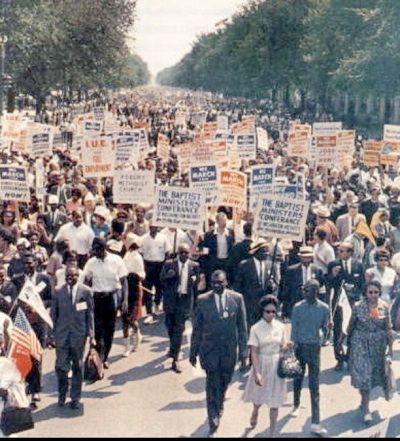
Photos of the 1963 Civil Rights March on Washingto,
I first wrote The Rise and Fall of the Civil Rights Movement essay in September 2006. Due to the emergence of Barack Obama as a Presidential Candidate, in 2008, I feel the necessity to update this article.
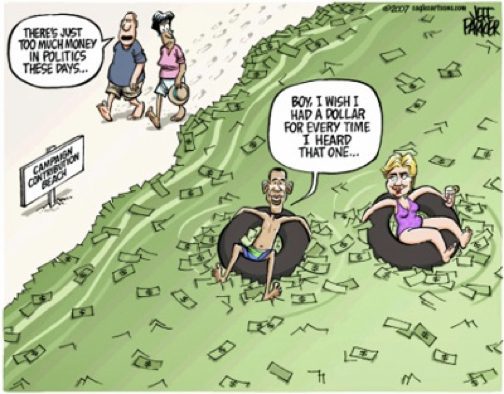
In the last quarter of 2007 alone, Barack Obama and Hilary Clinton each raised about $25 million apiece. During the course of the primary election fight they will spend Hundreds of millions of dollars! In fact, they are on a record setting pace for total spent for Presidential elections. So far, “Hillary Clinton and Barack Obama place first and second place in terms of the most money raised (at $116 million and $102 million respectively). Republicans’ funds are less in comparison, with frontrunner John McCain raising $41 million, and Mitt Romney, Rudy Giuliani, and Mike Huckabee respectively at $88.5 million, $60.9 million, and $9 million.” 1
The capitalist ruling class is voting, with most of their money, for a Hilary/Barack “change” and a side bet on a McCain “change” to maintain the status quo. But there will be no change in how the government is run, whether Clinton, McCain, or Obama win the election. Does anyone seriously propose that Obama or Clinton will oppose the money and power that elected them? Or that Obama will remember where he came from when his is elected, even though he does not come from the Black Community in the United States?
Clinton and Obama state that they will somehow end the war against Iraq, but they vote for funding the war, while they vote for the cuts for much needed social services and health, education and welfare. They say they oppose the racist drug laws, but they do not oppose these in the Senate, where they both hold power. Do people really believe that we will win national health care, in this country, when social services are being cut or privatized by the government? The only time when national health care has been won, anywhere in the world, has been when the working class has built their own political power, organized independently of the capitalist class. As Frederick Douglas often said, “power only recognizes power.” Where is our power? Where is own party? Where is our movement? – It is yet to be organized. Social Security would never have been won during the depression if it were not for the rise of the CIO and a mass Socialist Party.
They have no real position on any question that opposes the status quo. One thing to which they give lip service is that they support the rights of Blacks. But, while they are both opposed to the genocide and aids epidemic in Africa, they say nothing about the Black genocide – the infant mortality rate amongst Blacks (14 deaths per thousand), and the aids epidemic here in the United States, where the majority of aids victims are now Black.
Dr. Ahimsa Sumchai in her article, Black Flight, about the gentrification of Bay View Hunters Point (BVHP) in San Francisco, concludes her well written article with: “Thus, the appellants argue the BVHP Redevelopment plan fulfills United Nations working and operational definitions of a government sponsored genocidal campaign.”
Prior to Hurricane Katrina it would have been very difficult for the ruling rich to remove the majority Black population of New Orleans. But as Greg Palast commented on the divisions in society, in his article, Burn, Baby, Burn – the California Celebrity Fires:
“In 2005, while the bodies were still being fished out of flooded homes in New Orleans, Republican Congressman Richard Baker praised The Lord for his mercy. ‘We finally cleaned up public housing in New Orleans. We couldn’t do it, but God did,’ he said about the removal of the poor from the project near the French Quarter much coveted by speculators.”
From New York to San Francisco and from Chicago to New Orleans – nationwide – the Democrat- and Republican-led Federal, State, and Local governments has been displacing the poor Black inner city populations to the countryside, leaving them to fend for themselves.
Always remember, that the Democrats would have won the election in 2002, if they had stood up for the civil rights of disenfranchised Black people. The lesson that should be understood is that they do not support and defend civil rights, even if it means the Presidency!
It is important to point out that the demise of every social movement in the United States can be marked from the point that the leadership of the different movements subordinated those movements to support to the Democrat Party as the lesser the lesser evil to the Republican Party. It is especially important, in this day and age, to tell the truth that both of these political parties are owned by the ruling corporate rich in this country, just as they own over 95% of the mass media.2 It is their government – not ours!
What I wrote in 2006 is being proven true during the Barack Obama Presidential Election campaign. Some in the Black “talented tenth” are even calling ex-President Bill Clinton, “the first Black President”. What a joke. “Slick Willie,” who very proudly states that he ended affirmative action, was a proud enforcer of the racist drug laws, etc., and who, when he was out of office, moved his office to Harlem as part of that area’s gentrification process!
In her recent Black Commentator article, Lenore J. Daniels wrote:
“The greatest danger to Black liberation in the U.S. is not conceding that our continuing submission to Republicrat politics will result in our collective demise. Those who have subsisted on the morsels of private gains will find themselves regurgitated or excreted as waste upon the dump heap filled with the remains of our humanity. Our lives now are so much waste for some, taken for granted by others, and treated with indifference by many. Deciding whether cooperation with the Republicrats will finally, at last, free our children or sell them down the river is not an option at this late date. It’s strange to hear us sing a new and a strange song: ‘we don’t have a choice. We don’t have a choice.’ People, where have we been all these 40 years, all these 400 years? The greatest danger to Black liberation is for us to believe that Senators Barack Obama or Hillary Clinton will respect us as human beings. It would be foolish in this “post-racial moment” to think that either of these two supporters of imperialism will suddenly change and hold this nation accountable for its human rights violations within and without its borders.”
In her February 7, 2008 Black Commentator article, Dr, Daniels, who was organizing against slumlords in Chicago while Obama was working for them, states:
“No, Mike, you and Black America shouldn’t expect Senator Barack Obama to change! Rather than working in the trenches with the people themselves and making the city of Chicago accountable for the conditions Black Americans have to endure, Obama has always invested his efforts with the authorities, whether it was with the Daley Machine or with the moneyed foundations. He made a conscious decision to climb the ladder to civic leadership and perhaps his decisions benefited him and his family but it did little to help the Blacks he found in dire straights on his return to Chicago in 1991. To use Mumia Abu-Jamal’s words, ‘with a ‘brutha’ like Obama who needs enemies?”’
From my experience in San Francisco, where the powers that be elected Willie Brown, as the first Black mayor in order to start the final process of its gentrification in the Bay View Hunters Point area, the last Black Community in San Francisco, the ruling capitalist class is betting their money on Obama to overturn the gains made by the Civil Rights Movement.
Remember, the 13th amendment to the constitution did not abolish slavery for prisoners. The Prison Industry is now a growing capitalist concern, while the majority of prisoners are non-white and poor. The racist drug laws provide labor to these prison industries. It is not just segregation that is now coming back; slavery is also coming back through the prison system!
Footnotes:
Obama leading the Four Horsemen Of The Apocalypse
US Imperialism Spreading War, Famine, Pestilence, and Death.
The Rise and Fall of the Civil Rights Movement
This article was originally publish on September 5, 2006, by Counterpunch.com under the title: Where Will Blacks Find Justice? The Civil Rights Movement is Dead and So is the Democratic Party.
The first civil and human rights movement by and for Black people started during the Civil War and the period of Black Reconstruction that followed. It was a time of radical hopes for many freed slaves. But it was also a time of betrayal. Then President Andrew Johnson and the non-radical Republicans, in collusion with the Democratic Party, the party of slavery, sold out the early post-war promises for full equality and “40 acres and a mule”. Instead, the promise of equality was soon replaced by the restoration of the property rights of the former slave owners in the South. This was accomplished by the Compromise of 1877
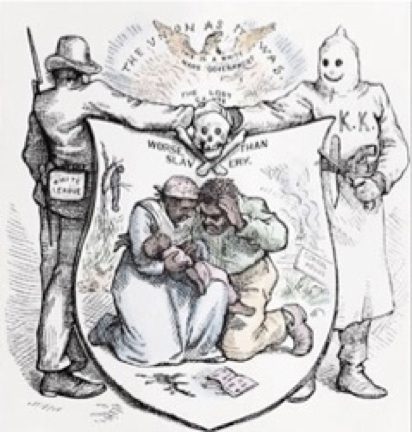
“Worse Than Slavery”
“Compromise—Indeed!
Harper’s Weekly Cartoons by Thomas Nast Depicting the Plight of African-Americans During Reconstruction and His View of the “Compromise” of 1877
Terrorism
How did they accomplish this betrayal? The answer is simple—terrorism. They used police and terroristic Ku Klux Klan violence. These extra-legal activities laid the basis for the overthrow of Black Reconstruction and the institutionalization of legal segregation (Jim Crow) in the former slave states. To enforceJim Crow, Black people were, for decades, indiscriminately lynched and framed.
“This was the status quo in the United States until the United States Supreme Court came out with its “Brown v. Board of Education” decision in 1954, mandating the right to equal education. The successful yearlong Montgomery Bus Boycott in 1955-56 reflected the new, more militant mood among Negroes (the name given to Black people by the ruling class). This new mood was a product of the rise of the Black Liberation movements in Africa, the confidence gained by the Black working class during the rise of the CIO, and the respect, knowledge, and expectations of democracy gained by Black soldiers during the Korean War.”1 (For more information about the boycott read my article:50 Years Later: Lessons from the Montgomery Bus Boycott.)
Thus the struggle againstJim Crow had begun, and with each victory to integrate and enforce the 1954 Supreme Court decision, the mass of Black people gained confidence in themselves and that the fight for racial equality could be won. In the early sixties, the movement grew stronger as young people from the universities spearheaded the ‘freedom rides’ and sit-ins throughout the South to opposeJim Crow and enforce the law of the land, which the local, state, and federal governments had refused to enforce.
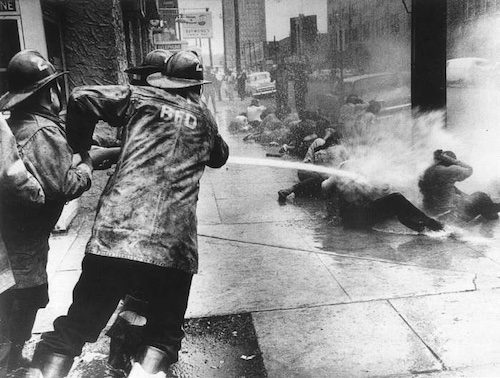
In the spring of 1963, the struggles in Birmingham, Alabama, led by the Black working class, garnered international attention when police commissioner Eugene (”Bull”) Connor unleashed powerful water hoses and German shepherd police dogs against the demonstrators. Terror and violence gripped this city, while the world watched. Indeed, it was the national and international embarrassment that forced President Kennedy and the government to begin to take governmental action.
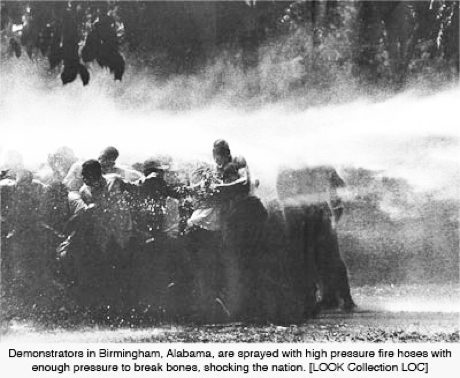
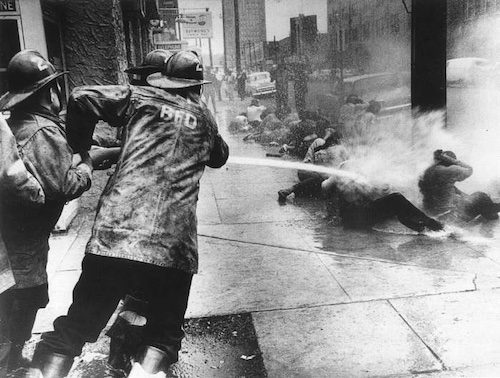
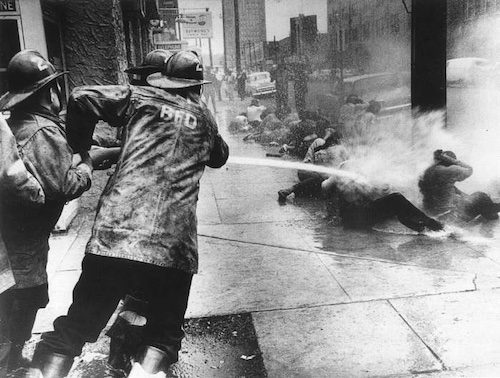
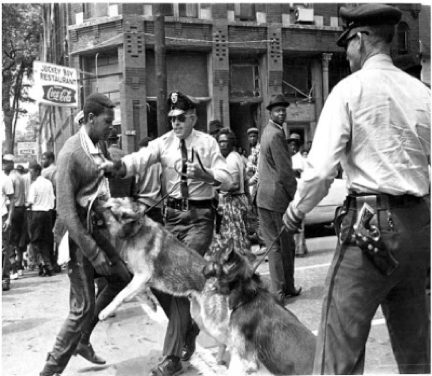


After Birmingham, the March on Washington was called. In the space of a few months, a huge demonstration was built. This demonstration was the largest social action in the United States since the mass strikes that led to the rise of the CIO in the 1930s and late 1940s. This mass action led to the passage of the Civil Rights Act in 1965.
At that rally, the Student Non-Violent Coordinating Committee (SNCC) Chairman John Lewis was prevented from delivering his prepared speech by the march organizers. It was a notable omission.
In this speech, he was going to say:
“. . . . We are now involved in a serious revolution. This nation is still a place of cheap political leaders who build their career on immoral compromises and ally themselves with open forms of political, economic and social exploitation. What political leader here can stand up and say ‘My party is the party of “principles”’? The party of Kennedy is also the party of Eastland. The party of Javits is also the party of Goldwater. Where is our party?”2
But if Lewis could be prevented by the March organizers from offending the liberal Democratic establishment from the stage of the Washington march, they could not prevent the civil rights movement from embracing a growing militancy and desire to expand the struggle to embrace a larger vision of social change.
Unfortunately, the momentum that was gained from the March was lost during the 1964 Presidential election campaign, when the major civil rights groups called for a moratorium on demonstrations in order not to embarrass then President Lyndon Baines Johnson during the election campaign against the “greater evil” Barry Goldwater. (Both were defenders ofJim Crow prior to the 1963 March on Washington.) The movement never fully recovered to this subordination of the struggle to “lesser evil” political action.
While the struggle in the South was specifically againstJim Crow, the struggle in the North was against de-facto segregation. The images of the dogs etc. on TV being used against Blacks in the South subsequently gave rise to the Black Nationalist movement in the North. The rise of the Black Muslims and Malcolm X was a reflection of the mood in the majority of the Black ghettos in every major northern city, where the economic and political power of Black people was more concentrated and greater than in the rural south. The rise of the nationalist movement consequently generated heated debates within the movement between the strategies of peaceful disobedience and righteous self-defense.
In his latter years, Malcolm X saw the Black struggle as a struggle for human rights, and, notably, as an anti-capitalist economic struggle. As he explained at the Militant Labor Forum in the fall of 1964:
“It’s impossible for a chicken to produce a duck egg… The system in this country cannot produce freedom for an Afro-American. It is impossible for this system, this economic system, this political system, period… And if ever a chicken did produce a duck egg, I’m certain you would say it was certainly a revolutionary chicken.” – Malcolm X (”Not Just An American Problem”)3
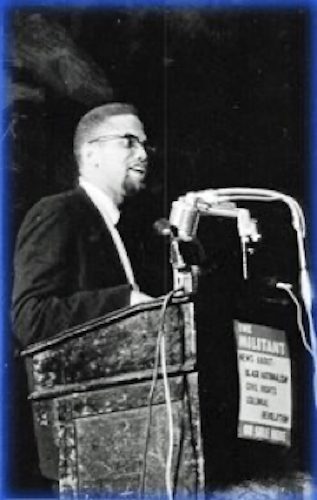
Malcolm X speaking at the New York Militant Labor Forum, 1964 Photo by Eli (Lucky) Finer
Unfortunately, Malcolm X was assassinated in 1965 before he could build an organization to follow in his footsteps.
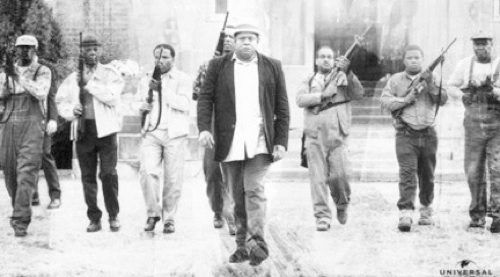
However, righteous self-defense, became a call of the Deacons for Defense and Justice, during this time:
The Deacons for Defense and Justice was an armed self-defense African-American civil rights organization in the U.S. Southern states during the 1960s. Historically, the organization practiced self-defense methods in the face of racist oppression that was carried out under the Jim Crow Laws by local/state government officials and racist vigilantes. Many times the Deacons are not written about or cited when speaking of the Civil Rights Movement because their agenda of self-defense – in this case, using violence, if necessary – did not fit the image of strict non-violence that leaders such as Dr. Martin Luther King Jr. espoused. Yet, there has been a recent debate over the crucial role the Deacons and other lesser known militant organizations played on local levels throughout much of the rural South. Many times in these areas the Federal government did not always have complete control over to enforce such laws like the Civil Rights Act of 1964 or Voting Rights Act of 1965. The Deacons were instrumental in many campaigns led by the Civil Rights Movement. A good example is the June 1966 March Against Fear, which went from Memphis, Tennessee, to Jackson, Mississippi. The March Against Fear signified a shift in character and power in the southern civil rights movement and was an event in which the Deacons participated. . . Scholar Akinyele O. Umoja speaks about the group’s effort more specifically. According to Umoja it was the urging of Stokely Carmichael that the Deacons were to be used as security for the march. Many times protection from the federal or state government was either inadequate or not given, even while knowing that groups like the Klan would commit violent acts against civil rights workers. An example of this was the Freedom Ridewhere many non-violent activists became the targets of assault for angry White mobs. After some debate and discussion many of the civil rights leaders compromised their strict non-violent beliefs and allowed the Deacons to be used. One such person was Dr. King. Umoja states, “Finally, though expressing reservations, King conceded to Carmichael’s proposals to maintain unity in the march and the movement. The involvement and association of the Deacons with the march signified a shift in the civil rights movement, which had been popularly projected as a ‘nonviolent movement.”‘[7]— Wilkipedia
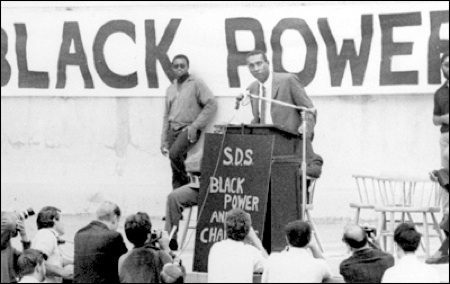
Following the assassination of Malcolm X, Stokely Carmichael, later known as Kwame Ture, became the new leader of SNCC and is credited with starting the movement for Black Power. In Lowndes County Alabama in 1965, he helped the Lowndes Country Freedom Organization (LCFO) to formtheir own party. The symbol of the party was the Black Panther and they were called the Black Panthers because of that symbol. The Alabama Democrats retaliated against this movement by evicting sharecroppers and tenant farmers, and attempting illegal foreclosures against Black Panther supporters. They even threatened to kill any African-American who registered. Thus the political activities of the LCFO inspired the formation of the Black Panther Party in Oakland, Calif. And, in the course of time, Black Panther Parties arose throughout the country.
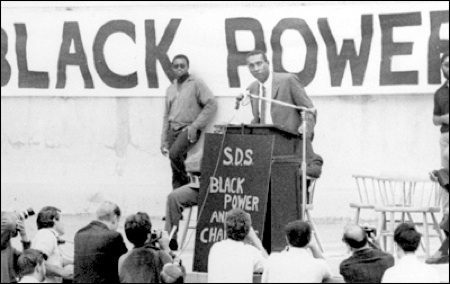
Stokely Carmichael Speaking to Black Power and Change Conference October 1966, Berkeley, CA
Due to the mass mobilizations by the civil rights movement and the Black rebellions in the inner cities, by 1968 legal segregation,Jim Crow, was destroyed. Blacks acquired the right to vote and access to jobs through affirmative action programs, to make up for the past discriminations. There was hope for a better life in the Black Community. However, after Martin Luther King, struggled against de facto segregation in Chicago, he realized that the struggle for economic equality was a more difficult fight than the struggle againstJim Crow. At this point he began to take similar anti-capitalist positions as Malcolm X.
Both Malcolm X and Martin Luther King opposed the Vietnam War prior to their assassinations. At the time of their assassinations, both Martin Luther King and Malcolm X were embarking on a course in opposition to the capitalist system. It is clear from reading and listening to their final speeches that they had both evolved to similar conclusions of capitalism’s role in the maintenance of racism. That is why they were assassinated. (For more information readThe Assassinations of Martin Luther King, Jr. and Malcolm X.4
It’s now known that during the rise of the modern civil rights movement, the government, led by Attorney General Robert F Kennedy, was spying on the movement and its leadership. In the 1970’s, the “Cointelpro” disruption operations by the government against the civil rights movement, the antiwar movement, and radicals and socialists, during that period, also became public knowledge. Under “Cointelpro” the different United States spy agencies used informers, agents, and agent provocateurs to disrupt organizations. One purpose of this program was to “neutralize” Malcolm X, Martin Luther King, and Elijah Muhammad,” in order to prevent the development of a “Black Messiah,” who would have the potential of uniting and leading a mass organization of Black Americans in their quest for freedom and economic equality.
IN 1967, King clearly wrote his outlook for the struggle to gain economic equality:
- “There is nothing but a lack of social vision to prevent us from paying an adequate wage to every American citizen whether he be a hospital worker, laundry worker, maid, or day laborer.
- “There is nothing except shortsightedness to prevent us from guaranteeing an annual minimum-and livable-income for every American family.
•“There is nothing, except a tragic death wish, to prevent us from reordering our priorities . . . - “The coalition of an energized section of labor, Negroes, unemployed, and welfare recipients may be the source of power that reshapes economic relationships and ushers in a breakthrough to a new level of social reform.
- “The total elimination of poverty, now a practical responsibility, the reality of equality in race relations and other profound structural changes in society may well begin here.”5
At that time, the stock market was below 1,000 points. Today, it is above 10,000 points, and yet there still is no social vision for paying an adequate wage and the minimum wage has dropped 42% since 1968.
Unlike Malcolm X, whose assassination cut short his organizing plans, King was organizing a movement to obtain his stated goals when he was assassinated. In fact, he was in Memphis to build that “coalition of an energized section of labor, Negroes, unemployed, and welfare recipients” in support of striking municipal sanitation workers.
If such a force had been launched, the whole power of the antiwar and civil rights movement in the 1960s could have transformed the labor movement and become “the source of power that reshapes economic relationships and ushers in a breakthrough to a new level of social reform.”
To combat the rise of the Civil Right Movement, the “war on poverty” was first launched in 1965 along with the concept of “Black Politicians”. Malcolm X described this process in his Jan. 7, 1965 speech “The Prospects for Freedom”, at the Militant Labor Forum, in New York City (For complete an audio of the speech go here.)
“They have a new gimmick every year. They’re going to take one of their boys, black boys, and put him in the cabinet so he can walk around Washington with a cigar. Fire on one end and fool on the other end. And because his immediate personal problem will have been solved he will be the one to tell our people: ‘Look how much progress we’re making. I’m in Washington, D.C., I can have tea in the White House. I’m your spokesman, I’m your leader.’ While our people are still living in Harlem in the slums. Still receiving the worst form of education. But how many sitting here right now feel that they could [laughs] truly identify with a struggle that was designed to eliminate the basic causes that create the conditions that exist? Not very many. They can jive, but when it comes to identifying yourself with a struggle that is not endorsed by the power structure, that is not acceptable, that the ground rules are not laid down by the society in which you live, in which you are struggling against, you can’t identify with that, you step back.“It’s easy to become a satellite today without even realizing it. This country can seduce God. Yes, it has that seductive power of economic dollarism. You can cut out colonialism, imperialism and all other kind of ism, but it’s hard for you to cut that dollarism. When they drop those dollars on you, you’ll fold though.”6
After the assassination of Martin Luther King and the subsequent rebellions in the inner cities protesting his assassination, the Democratic Party’s “war on poverty” started laying dollars on any potential Black leaders and grooming Black Candidates.
John Lewis, formally of SNCC, became enlightened, he forego the Black Panthers and saw the Democratic Party, symbolized by a jackass, as his party. Most of what W.E. B. Dubois described as the “talented tenth” were bought off by this process. The more radical concepts that Martin Luther King and Malcolm X had developed at the time of their deaths disappeared from the scene. No one took up where they left off. The governmental policy, directed towards the ‘leaders’ of the civil rights movement, of the carrot (dollarism) and the stick (assassinations) had proven to be successful.
A last chance at rebuilding the movement was the first National Black Political Assembly on March 10,1972. “Eight thousand African Americans (three thousand of whom were official delegates) arrived in Gary, Indiana, to attend their first convention, which was more commonly known as the ‘Gary Convention.’ A sea of Black faces chanted, ‘It’s Nation Time! It’s Nation Time!’ No one in the room had ever seen anything like this before. The radical Black nationalists clearly won the day; moderates who supported integration and backed the Democratic Party were in the minority.7 It gave birth to the “Gary Declaration” which stated:
“. . . A Black political convention, indeed all truly Black politics, must begin from this truth: The American system does not work for the masses of our people, and it cannot be made to work without radical, fundamental changes. The challenge is thrown to us here in Gary. It is the challenge to consolidate and organize our own Black role as the vanguard in the struggle for a new society. To accept the challenge is to move to independent Black politics. There can be no equivocation on that issue. History leaves us no other choice. White politics has not and cannot bring the changes we need.”8
Unfortunately, Black Democratic Party supporters such as Richard Hatcher the mayor of Gary Indiana, Jesse Jackson, Ron Daniels, and even Amiri Baraka betrayed the hope from the Cary Convention. Instead of the course that was decided at the convention, they led the way to support Black politicians and through them, the Democratic Party. “Vote for Me and I’ll set you Free” became the slogan for the day and the civil rights movement became completely demobilized and with its “leaders co-opted” into the system. From this demobilization, came the betrayal and atomization of the movement.
As Malcolm X said in his New York City speech, Dec. 1, 1963: “The Negro revolution is controlled by foxy white liberals, by the Government itself.9”
At first, there was an illusion of progress; there was a rise in the number on Black politicians. There was an increase in jobs for black professionals in government, in industry, and on television. There was an impression that things were getting better through the strategy of relying upon the Democratic Party to politically secure, protect, and advance the struggle for racial equality.
An example of what was wrong with this strategy was clearly demonstrated when Maynard Jackson was elected mayor of Atlanta Ga., in 1974.
At the time of Martin Luther King’s assassination, he was willing to risk jail and to organize a mass demonstration, in defiance of a court injunction and National Guardsmen, in armored personnel carriers equipped with 50-caliber machine guns, to help the striking Memphis municipal garbage workers. These workers ultimately won their union contract, and thousands of ordinary working families in that city got living wages that allowed them to educate their children, buy houses, live decent and dignified lives, and even retire.
In his last speech, he stated:
All we say to America is, “Be true to what you said on paper.” If I lived in China or even Russia, or any totalitarian country, MAYBE I COULD UNDERSTAND SOME OF THESE ILLEGAL INJUNCTIONS. Maybe I could understand the denial of certain basic First Amendment privileges, because they HAVEN’T committed themselves to that over there. But somewhere I read of the freedom of assembly. Somewhere I read of the freedom of speech. Somewhere I read of the freedom of the press. Somewhere I read that the greatness of America is the right to protest for RIGHTS. And so just as I say, WE AREN’T GOING TO LET ANY DOGS OR WATER HOSES TURN US AROUND, we aren’t going to let any injunction turn us around.
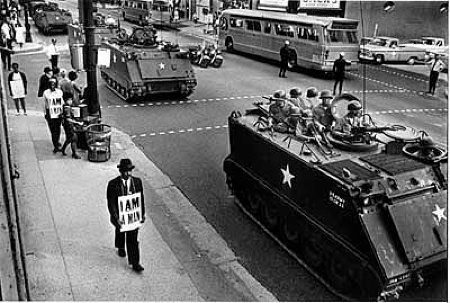
“I Am A Man’March 29, 1968: Scene in Memphis
In contrast, Maynard Jackson quickly demonstrated that he was not beholden to or a leader of the Black population that elected him, but beholden to those who financed his election campaign and who helped his personal political and financial advancement. In Atlanta, Jackson, instead of helping city sanitation workers, fired more than a thousand city employees to crush their strike. In this, he had the support of white business leaders and the Atlanta Journal-Constitution.
This contrast was clearly stated in the essay A disgrace before God: Striking black sanitation workers vs. black officialdom in 1977 Atlanta :
Memphis in 1968 best demonstrated this connection, where wildcat strikes by an all-black workforce against overtly racist city officials became a larger battle for black liberation and community self-management. This struggle eventually saw the involvement of Dr. Martin Luther King Jr. and other civil rights establishment figures. When Dr. King was assassinated the day after giving a stirring speech to assembled sanitation workers, victory for striking workers followed shortly for much of American liberal official society sympathized with the strikers against the racist city officials. The city recognized the strikers’ call for union recognition, nationally backed by the American Federation of State, County, and Municipal Employees (AFSCME) and conceded to demands for better pay and improved workplace conditions. This scene repeated itself in St. Petersburg and Cleveland later that year. This also occurred in Atlanta in 1970, where civil rights figures, some of whom were newly elected city officials, supported striking sanitation workers threatened with termination by Atlanta’s white mayor Sam Massell.
Fast-forward seven years to the Atlanta of 1977 and something strange, one may think, happened. The script was flipped. The same black officials who supported sanitation workers against firings by a white mayor decided to replace striking city sanitation employees with scabs. This occurred with the full support of many old guard civil rights leaders and organizations, allied with business and civic groups associated with Atlanta’s white power structure during Jim Crow segregation. What explains the apparent about-face by black officials? The Atlanta strike of 1977 shows the coming of age of a coalition of black and white city officials, along with civic and business elites, under the leadership of the city’s first black mayor, Maynard Jackson. Just seven years earlier Jackson publicly sided with sanitation workers against a white mayor seeking to fire them. Jackson and some members of the civil rights establishment, in positions of local government by the mid 1970s, did not hesitate to marshal the forces of official society against the self-activity of black workers. They allied with white business and civic elites, the same people that just a few years earlier openly supported white supremacist segregation, all in the name of smashing the sanitation workers’ strike by any means necessary.
This showed the open class hatred of black and white elites against working people, a prominent feature of communities in Atlanta for generations.
Similar fruits, from the political policy of supporting the “lesser evil” Democratic Party, has led to a set back for the struggle for civil rights and equality.
“Lesser evil” always means “More Evil”— the Republican Richard Nixon, the “greater evil” in 1968, would be the “lesser evil” to the Democrat Clinton (Bill and Hillary) in today’s world!
No longer fearing a mass civil rights movement in the streets, the Democrats have, for the past 30 years, shared responsibility for the gradual reduction of affirmative action and the victories of the movement.
From my own experience, the only way to enforce affirmative action, is if there are quotas for employment in the workplace. The new Black politicians, along with Jessie Jackson, came out against quotas in the 80s, helping to make affirmative action more difficult. Various court decisions helped to reduce the effects of affirmative action and to resegregate the nation’s school system. In 1995, President Clinton, as the leader of the Democratic Party, drafted a memorandum for the elimination of any program that creates (1) a quota; (2) preferences for unqualified individuals; (3) creates reverse discrimination (The slogan of the racists); or continues affirmative action even after its equal opportunity purposes have been achieved.” (A myth)
Actually, according to a recent article from the Boston Globe, at the elite colleges, there is affirmative action for rich dim white kids.10
The Democratic Party was responsible for the 1986 Anti-Drug Abuse Act which established a 100-to-1 sentencing ratio between possession of crack (mainly used in the inter-cities) and of cocaine powder (mainly used in the suburbs). Under this law, possession of five grams of crack is a felony and carries a mandated minimum five-year federal prison sentence. For cocaine powder it is only a misdemeanor for the possession of less than 500 grams of cocaine powder. The five-year felony sentence applies if one has 500 grams in their possession. This sentencing disproportion was based on phony testimony that crack was 50 times more addictive than powdered coke. The Democratic Party-controlled Congress then doubled this ratio as a so-called “violence penalty”.
This has led to “affirmative action” in the prison system, where Black inmates are a far greater in percentage of all prisoners than their percentage in the nation. At the same time, many states are now preventing those convicted of a felony from voting.
According to the Harvard Civil Rights Project, which recently was forced to move to UCLA, the public schools have become more separate and unequal— the consequences of the last two decades of resegregation along economic, ethnic and racist lines.11
Throughout this land, both the Republican and Democratic Parties are gentrifying the inner cities, in the service of big business, and the poor are being scattered to the winds. It is how the rich are handling unemployment and poverty in this country. Recently, Black U.S. Senator Barack Obama (D-IL) went to Africa to publicize the catastrophe of Aids in Africa. He should have also gone to the Black Communities in the United States and publicized the crisis of Aids in Black America, where nearly half of the million Americans, who are living with HIV today, are Black. In fact it has become a Black disease.12
The bipartisan corporate “bankruptcy reforms” in the late 80s to the present have allowed corporations to lay off workers, rob pension plans, and tear up union contracts. Because Black workers are still the “last hired and first fired”, they have received the brunt of these attacks.
Overall, the rich have become richer, and the poor have become poorer.
Ben H. Bagdikian put it well in his “Preface to the Sixth Edition” of theThe Media Monopoly, after he explained that just six of the world’s largest corporations, control 95% of the mass media, he wrote:
“The American economy [has been] undergoing an astonishing phenomenon that the mainstream news left largely unreported or actually glamorized in its infrequent references, the largest transfer of the national wealth in American history from a majority of the population to a small percentage of the country’s wealthiest families.”13
This process was facilitated by the fact that almost every “tax reform” from Kennedy in 1961, to Bush in 2004, has resulted in the taking of wealth from the working class and giving it to the capitalist class.
And yet, the Congressional Black Caucus echoes the “hype” from the government, the press, and the Republican and Democratic Parties, that things are better today. The economic figures from the bipartisan wage-price freeze in 1972 to today demonstrate that this it is false illusion. he Congressional Black Caucus echoes the “hype” from the government, the press, and the Republican and Democratic Parties, that things are better today. And yet, racism continues to be an institutional part of the United States.
According to infoplease14, Black households median income in 1972 was $21,311 or $97,201.78 in 2005 dollars, while white Households median income in 1972 was $36,510 or $166,526.06 in 2005 dollars. In 2004 Black households had a median income in 2004 was $30,947 in 2005 dollars. White Households had the highest median income at $47,957 in 2005 dollars. Significantly lower than the median incomes for 1972.15
These figures show that Black Households median income in 1972 was 58% of white households median income and approximate 64% of white households today. This does not represent progress, it represents that income for workers, Black People and other minorities has decreased since 1972. Black people now have an income of 64% of white households that has not kept up with inflation and has actually decreased by over 50% since 1972.16 Since the working class and the poor have been suffering an ever-increasing rate of taxation and concurrent cuts in government services, the decline in real wages and their standard of living has been worse.
In order to regain what has been lost and win equality rights for all, we must stop supporting those who are oppressing us – the Democratic and Republican Parties – and go back to what made all movements powerful. Which was relying upon ourselves and building our own independent power.
In his book, Where do we go from here: Chaos or community?, New York: Harper & Row, 1967, King wrote the course that he was planning to take in the fight for economic equality:
“There is nothing, except a tragic death wish, to prevent us from reordering our priorities… The coalition of an energized section of labor, Negroes, unemployed, and welfare recipients may be the source of power that reshapes economic relationships and ushers in a breakthrough to a new level of social reform.…. The total elimination of poverty, now a practical responsibility, the reality of equality in race relations and other profound structural changes in society may well begin here.” Where Are we going.pdf?
. . .“In 1968, having won landmark civil rights legislation, King strenuously urged racial justice advocates to shift from a civil rights to a human rights paradigm. A human rights approach, he believed, would offer far greater hope than the civil rights model had provided for those determined to create a thriving, multiracial democracy free from racial hierarchy. It would offer a positive vision of what we can strive for-a society in which people of all races are treated with dignity and have the right to food, shelter, health care, education, and security.
“We must see the great distinction between a reform movement and a revolutionary movement,” he said. “We are called upon to raise certain basic questions about the whole society.” The Poor People’s Movement seemed poised to unite poor people of all colors in a bold challenge to the prevailing economic and political system.”. . . — Michelle Alexander, Think Outside the Bars Why real justice means fewer prisons.
Such a coalition, as King envisioned it thirty-three years ago, is needed today.
In order to survive, we must begin the begin.
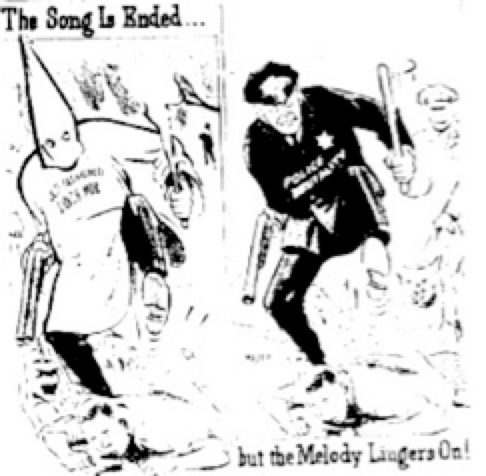
http://www.muhammadspeaks.com/Police&KKK.gif

For a graphic video on how race relations have not changed in this country go to :http://www.komotv.com/home/video/5001856.html?video=YHI&t=a
September 2006
Footnotes
- http://www.counterpunch.org/sheppard11112005.html
- The Militant , September 9, 1963
- http://panafricannews.blogspot.com/2007/11/malcolm-x-40-years-then-and-now.html
- http://www.holtlaborlibrary.org/malcolmx.htm
- King, Where do we go from here: Chaos or community?, New York: Harper & Row, 1967
- http://www.accuracy.org/newsrelease.php?articleId=987
- http://www.aaregistry.com/african_american_history/1559/First_National_Black_Political_Convention_held___
- http://www.blackpast.org/?q=primary/gary-declaration-national-black-political-convention-1972 .