
Daily News 10/27
Daily News 10/27
Daily News Archives Since June 2026
Lula wins fourth term as Brazil president after historic upset over far-right Flávio Bolsonaro

Brazil: mass mobilisation defeats Bolsonaro – build the communist alternative!In an unprecedented turnaround, Lula has won the second round of the Brazilian presidential election. Such a turnaround had never happened before.
Demonstrations Across Colombia Target New President and US InterventionThe anti-government demonstrations that recently rocked Colombia erupted only two months after President Abelardo de la Espriella took office, on August 7. The framework surrounding them is large. Colombian academician Manuel Humberto Restrepo Domínguezrefers toa“humanistic outburst against fascism and capitalism in its genocidal phase … circulating through the streets of major cities in Europe, Latin America, and — starting on October 14 — in Colombia.” On that day, Colombians pilloried both the new president and US pretensions. Demonstrations took place in 62 locations and the capital cities of all 31 departments. Marshalled against the far-right De la Espriella, a novice politician, were thousands of protesting and marching unionists, workers, students, teachers, feminists, indigenous people, past office holders, and veteran activists of all stripes. The outpouring of dissent was extraordinary.
From October 17th to November 5th: how to win? October 17th marked a turning point in the development of the class struggle. On that day, countless workers joined forces with mobilized high school and university students. Every sector of the economy was represented. The atmosphere was exceptionally radical. Many demonstrators were not simply demanding specific measures, but a complete change of government and system—in short, a revolution. In response, the government is attempting to stifle the movement under a thick blanket of threats, lies, and state violence. Having categorized the high school student movement as “urban violence ,” bourgeois politicians and journalists are now screaming bloody murder, day and night, against the “unprecedented violence” of the “far left” and “thugs ,” this “coalition” whose architect and supreme leader is supposedly Jean-Luc Mélenchon. To save the country from the clutches of La France Insoumise (LFI), the government is intensifying police and judicial repression, imposing curfews, banning demonstrations, and announcing the mobilization of the army, the GIGN, and the RAID. Yesterday’s demonstrations, October 24th, were as massive and radical as the previous Saturday’s. This latest show of force is all the more remarkable given that Macron had declared on Thursday: “What is recommended is not to demonstrate .” In support of this “recommendation,” the government threatened the demonstrators, announced a massive police deployment, banned demonstrations, changed routes at the last minute, and so on. Everything was done to reduce the scale of the mobilization—in vain: it was a complete failure for the government, and a resounding success for the mobilized youth and workers. (Google Translate)
Albania’s Protests Show No Signs Of Backing Down
Serbia’s Student List preparing for talks on forming government despite no clear leader Non-hierarchical movement is seeking to ‘rebuild society’ in Balkan country after years of authoritarian rule
Fossil Full Inc. is a Ciminal Enerterrprize!
A Sane Society World Hold the Oil Companies Accountable for Their Crimes!
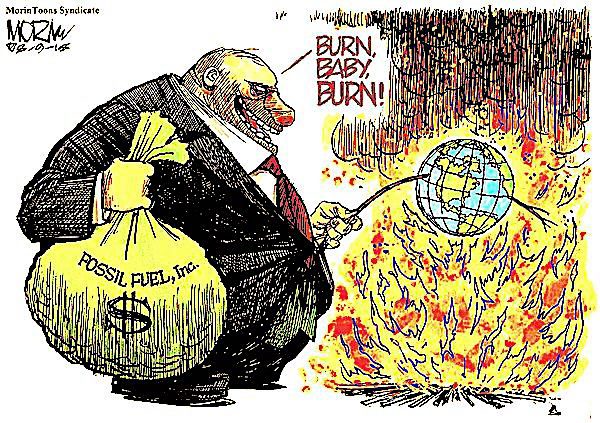
Big Energy/U.S. Capitalism Has Made a Conscious Decision to Commit Humanicide, Rather Than Lose Their Proing Enterprises: “The panelists examined the corporate genesis of the climate denial movement and the many methods of influence that have been utilized to stall effective climate change policy. Using documents and analysis found on Climate Files, Davies recounted how the largest oil majors, including Shell and Exxon, had extensive internal knowledge about climate change science and impacts decades before it became a topic of global concern. Rather than addressing the threat that their product posed to the world, the documents show that the fossil fuel industry engaged and funded a climate change countermovement to deny the urgency their own scientists knew to be true. The Climate Change Countermovement: Brown University Report and Panel”— (2019)
Fossil fuel firms could be tried in US for homicide over climate-related deaths, experts sayPublic Citizen, a non-profit group, proposed the idea last year to prosecute companies for millions of deaths due to climate crisis
Proximity to Oil Refineries and Risk of Cancer: A Population-Based Analysis Conclusions Proximity to an oil refinery was associated with an increased risk of multiple cancer types. We also observed statistically significantly increased risk of regional and distant/metastatic disease according to proximity to an oil refinery. Expansion of oil production in the United States has resulted in a record-high production of 18.8 million barrels per day, with Texas as the largest producer (1). Debate over potential health risks, primarily ensuing from emitted air pollutants, has been increasingly underscored in the public and legislative arenas (2-4). The International Agency for Research on Cancer has recognized and identified important sources of emissions from the petrochemical industries as environmental carcinogens (International Agency for Research on Cancer: monographs on the evaluation of carcinogenic risks to humans) (5). Prior studies have been conducted to investigate the rate of different cancers among residents who live near oil refineries (ie, petrochemical industrial complexes [PIC]). Lung cancer has been previously linked with polycyclic aromatic hydrocarbons exposure (6), with conflicting results on the risks of lung and other cancer sites according to PIC proximity (7-13). However, most studies have been conducted outside of the United States—in the setting of different sociodemographic characteristics for at-risk residents—which in turn make results difficult to extrapolate to the United States (14). Given this impetus, we sought to test the hypothesis that there is an increased cancer risk across different cancer types according to proximity to an oil refinery in Texas.
The Fossil Fuel Crime File: Proven Crimes and Credible Allegations An inventory of proven criminal, civil and administrative offences and credible allegations attributed to the fossil fuel industry You can read the publication below this article or download it here. Greenpeace Netherlands has published The Fossil Fuel Crime File: Proven Crimes and Credible Allegations, a compilation of proven criminal, civil and administrative offences and credible allegations attributed to large European fossil fuel companies, from 1989 to the present day. The Fossil Fuel Crime File compiles 17 different categories of unlawful activity – from fraudulent advertising, bribery, corruption and greenwashing, to human rights violations, manslaughter and even complicity in war crimes – backed up by 26 examples of criminal conduct, which are either formally established or credibly alleged. The Fossil Fuel Crime File lists 10 European fossil fuel companies that have been convicted, or credibly accused, of breaking the law – many of them several times over. This is the first qualitative compilation of its kind, which establishes a strong foundation to the claim that criminality is baked into the DNA of the fossil fuel industry. In a fast-moving world full of endless breaking news stories, it is easy to overlook fossil fuel companies’ criminality. However, by taking a closer look at several large European fossil fuel companies over the past thirty years, it’s undeniable that multiple crimes and other unlawful activities have taken place. Criminality is baked into the DNA of the fossil fuel industry, and its criminal activity is systemic. It is time the fossil fuel industry stops its criminal activities and is held accountable. It is time to ban new fossil fuel infrastructure projects and phase out all fossil fuels all over the world. We demand climate justice.
Fossil fuel racism in the United States: How phasing out coal, oil, and gas can protect communities Conclusions In this paper we have summarized the literature documenting both public health harms and disproportionate impacts to Black, Brown, Indigenous and poor communities at each stage of the fossil fuel lifecycle. We term this persistent and pernicious pattern “fossil fuel racism” and analyze it as a subset of the broader field of environmental justice studies. We argue that systemic racism subsidizes the fossil fuel industry by enabling it to externalize the costs of pollution and environmental degradation onto communities of color. The growing demand for robust solutions to the climate crisis has opened up political space for policies that could potentially address and even rectify these injustices. But not all climate policies are designed to take fossil fuel racism into consideration, and as a result climate policies will differ in their impacts on local air and water pollution, pollution disparities, and whose voices are heard in policymaking spaces. In particular, we have critiqued “carbon-centric” policies, which focus narrowly on GHG reduction, as likely failing to alleviate fossil fuel racism or potentially worsening it for some communities. A better approach is to shift focus “upstream” from GHGs to fossil fuels themselves. This puts the analytic focus directly on the state and non-state actors that organize, invest in and benefit from the fossil fuel system, and which are deploying their political and economic power to maintain it. If fossil fuel racism is a manifestation of racial capitalism spanning multiple scales, then illuminating the broader dynamics of how racial capitalism operates across scales could provide new solutions or points of resistance. This could involve a deeper look at the role of sacrifice zones within fossil fuel producing nations, but also the financial and political relations between countries of the global north and global south. For example, a greater focus on fossil fuels could unlock “powerful trans-local solidarity movements” by revealing and connecting the “interconnected positions” of distant communities along fossil fuel supply chains [14]. Shifting focus to fossil fuels also points the way towards a broader platform of policy solutions and trans-local resistance that stands a better chance of successfully addressing both climate change and fossil fuel racism than narrow carbon-centric policies. Responding to the three key attributes of fossil fuel racism, our policy recommendations fall into three categories.
Wars are Very Peofitable for Fossil Fuel Inc.: Revealed: major oil firms make $93bn profits amid war and climate crisis Guardian analysis found that the eight listed oil producers made almost $93bn (£69bn) in the three months to the end of June – the first full financial quarter after the US-Israeli war on Iran triggered a surge in global oil prices to highs above $126 a barrel. The companies have used the biggest disruption of fossil fuel supplies in the market’s history to almost double their combined profits from just under $50bn in the same period last year, with campaigners warning that millions of households are left paying the price in higher bills and climate chaos.The data suggests the eight oil companies – Aramco, BP, Shell, Equinor, TotalEnergies, Eni, Chevron and ExxonMobil – made more than $700,000 of profit every minute over the spring quarter. While their market valuations were swelling by about $600bn to above $3tn, temperatures built towards a run of deadly heatwaves, all made more likely and more severe by burning fossil fuels. Carbon emissions from the world’s biggest fossil fuel firms were directly linked to fatal spells of hot weather for the first time by scientific analysis published last September. It found the emissions from any one of the 14 biggest companies were each enough to cause more than 50 heatwaves that would otherwise have been virtually impossible.
ICE Raid on Ilhan Omar Shows How Dangerous Two Years of Flailing Trump Could Get With his popularity tanking and his grip on power growing tenuous, Trump is becoming a decrepit tyrant — and the checks to stop him are failing.
AI Has No Off Switch. People Asking for One Are Being Dragged Out of Town Halls. Three and a half years ago, the internet laughed at an AI-generated Will Smith shoveling spaghetti into his mouth, his face morphing into something grotesque between bites, the noodles thrashing like something alive.Now, over a gas station in Ukraine, past the point where any pilot is steering, guided by software trained to find propane tanks, a drone makes its own choice. Three people die at the pumps. The clip plays right after a recipe video. Nobody laughs.