
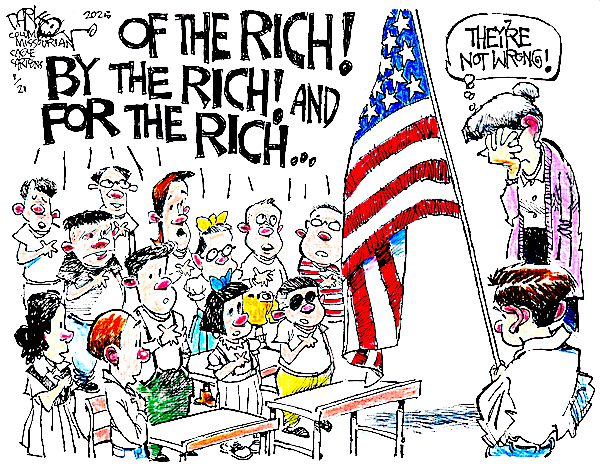
US is a Plutocracy!
US is a Plutocracy!
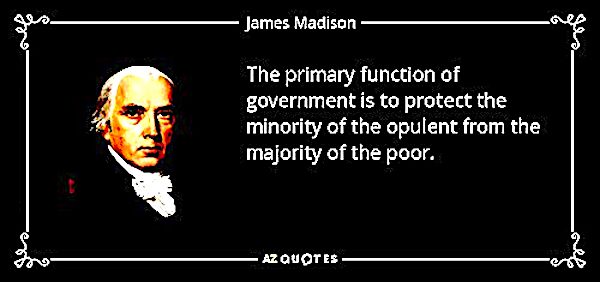
One of the Supreme Court’s ‘Founding Fathers’ James Madison:
Understanding Plutocracy: Rule by the Wealthy Explained DEFINITION Plutocracy is a government controlled exclusively by wealthy individuals, either directly or indirectly. KEY TAKEAWAYS
- Plutocracy is a government where only the wealthy have control.
- Wealth can influence policies, favoring the affluent indirectly.
- Campaigns and political support often depend on wealthy donors.
- The U.S. shows plutocratic traits despite being a democracy.
Some of the most subsidized recipients of public assistance are not welfare queens housed in public tenement apartments. They are not even poor or ailing at all. Far from it.
America’s most costly welfare recipients today are Fortune 500 companies. In 1997 the Fortune 500 corporations recorded best-ever earnings of $325 billion, yet incredibly Uncle Sam doled out nearly $100 billion in taxpayer subsidies.1 These welfare payments come in every conceivable shape and size: government grants, sweetheart business deals arranged by the Commerce Department, cut-rate insurance, low-interest loans, a protective wall against foreign competition, exclusive government contracts, and a mind-boggling maze of special interest loopholes in the tax code. Table 1 lists the 1997 appropriations for fifty-five of the most unjustified federal business subsidy spending programs as compiled by the Cato Institute. Their combined price tag came to $38 billion in 1997. All but a small handful of America’s wealthiest corporations have participated in the hunt for federal or state government subsidies. Most of these companies are double-, triple-, and quadruple-dipping. In 1996 General Electric won fifteen grants for $20.1 million. Rockwell International received thirty-nine grants for $25.4 million. Westinghouse Electric received fourteen grants for $26.1 million. Yet each of these companies had profits of at least half a billion dollars in 1996. All but a small handful of America’s wealthiest corporations have participated in the hunt for federal or state government subsidies. Most of these companies are double-, triple-, and quadruple-dipping. In 1996 General Electric won fifteen grants for $20.1 million. Rockwell International received thirty-nine grants for $25.4 million. Westinghouse Electric received fourteen grants for $26.1 million. Yet each of these companies had profits of at least half a billion dollars in 1996.Corporate welfare has all the systemic debilitating effects, including dependency and self-destructive behavior, that characterized the troubled legacy of the Great Society social welfare agencies. Just as the social welfare state became a pernicious, self-perpetuating industry inside Washington, so it is today with the corporate welfare state. For example, Representative Dick Armey has shown that the growth of the tax code and its special interest provisions has exactly paralleled the growth of the Washington K Street lobbying industry (see figure 1).In the mid-1990s Congress and the states–at the urging of the American voters–enacted major reforms in social welfare programs. There are now time limits on welfare benefits. Work, training, or education is now typically required in exchange for benefits. The result: welfare rolls are down by 40 percent over the past five years and record levels of former recipients now working and paying taxes, not collecting them. — Welfare for the Well-Off: How Business Subsidies Fleece Taxpayers
Welfare for the Wealthy Half of all business meal expenses are tax deductible. This puts SNAP cuts in helpful perspective.

US Government Big Oil Big Pharma Risk Free Profits AI OverviewThe U.S. government enables “risk-free” corporate profits for Big Oil and Big Pharma via legislative carveouts, patent monopolies, and tax loopholes. Recent 2026 Joint Economic Committee reports reveal massive industry windfalls—such as $125.2 billion for Big Oil during the Iran War—bolstered by political policies and federal investments Yahoo News.