
Daily News 10/12
Daily News 10/12
Daily News Archives Since June 2026
Why we should celebrate “Indigenous Peoples’ Day” instead of “Columbus Day”
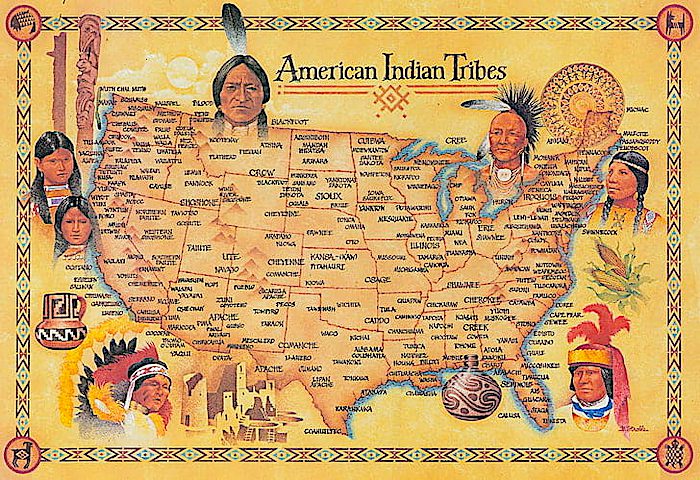
A map of the United States depicting the various Native American Tribes that existed prior to colonization; Source: Yahoo Images
The butchery continued until there were no Tainos left to butcher. One might well ask how a group of human beings, even those like the Spaniards of Columbus’ day, maddened in a collective lust for wealth and prestige, might come to treat another with such unrestrained ferocity over a sustained period. The answer, or some substantial portion of it, must lie in the fact that the Indians were considered by the Spanish to be untermenschen, subhumans. That this was the conventional view is borne out beyond all question in the recorded debates between Las Casas and the nobleman, Francisco de Sepulveda, who argued for the majority of Spaniards that American Indians, like African blacks and other “lower animals,” lacked ‘souls’. The Spaniards, consequently, bore in Sepulveda’s estimation a holy obligation to enslave and destroy them wherever they might be encountered.[19] The eugenics theories of nazi ‘philosopher’ Alfred Rosenberg, to which Heinrich Himmler more-or-less subscribed, elaborated the mission of the SS in very much the same terms.[20] It was upon such profoundly racist ideas that Christopher Columbus grounded his policies as initial governor of the new Spanish empire in America.[21] — Ward Churchill, Deconstructing the Columbus Myth
Video:Over 100 thousand attend pro-Palestine march in London despite significant restrictions!
Video: Shocking Images Of Storm Rachel MASSIVE WAVES FLOOD Newport Beach – 20 Blocks UNDERWATER
Video: Whoods Hole Oceanographic Instintution:. El Niño : The global implications of a “super” warm ocean in the eastern tropical Pacific
Imperialism’s Genocide: Columbus Day: Beginning of the Native American Genocide! Forgetting the Native American Genocide: over 55 million dead
From: Columbus vs. Indigenous Peoples’ Day By 1495 he was filling the order. His men rounded up 1,600 Taíno men and women, and on February 17 they loaded the 550 they judged best onto ships for Spain. Spaniards on the island were told to take as many of the rest as they pleased. Michele de Cuneo, who was there, wrote that many of the women who were released had infants at the breast. Afraid of being seized again, they left their babies on the ground and fled “like desperate people.” About 200 of the captives died on the crossing. The crew threw their bodies into the Atlantic. In the rest of this list, for Humanity Archive free subscribers
- The gold quota every Taíno over fourteen had to pay, or die
- The 1500 letter where Columbus wrote that girls of nine and ten were “in demand”
- What Columbus handed his friend on board, in the friend’s own words
- The torture his own men described when Spain investigated him
- The 1823 Supreme Court ruling that still counts his “discovery” as ownership
- The Taíno chief who chose hell over a Spanish heaven
- How 120 nations took October 12 back, and how Trump’s White House answered
Theory 101: Historical Materialism and the Legacy of ColumbusThe celebration of Columbus is a product of over five centuries of colonialism and capitalist development.
“The capitalist and imperialist systems that Columbus helped birth were met with fierce resistance from Indigenous people, African people, and poor people throughout the course of their development.”
Another celebration of the genocidal colonial legacy of Christopher Columbus has come and gone. The movement to eliminate Columbus Day in place of an Indigenous Peoples Day has found varying degrees of success in cities across the country. Indigenous Peoples Day reminds the Empire that Columbus was a mass murderer and reinforces the principled position that someone who so wholly represents the Western colonial extermination campaign of indigenous and African peoples should not be celebrated. But why is Columbus celebrated at all? The following article examines the question from the worldview of historical materialism, otherwise known as the materialist conception of history.
Entire books have been written about historical materialism. This article merely gives a definition and brief analysis of the relevance of historical materialism toward understanding the celebration of Columbus. Such a celebration goes beyond a mere analysis of facts which point to the establishment of the federal holiday as a response by President Franklin Roosevelt to the demands of the Knights of Columbus. The Knights asserted that Columbus should be celebrated as a demonstration of the commonalities between Italian “heritage” and the American way of life. However, historical materialism helps us understand that the centuries-long celebration of Columbus in the United States cannot be reduced to any singular moment in history and speaks more to the development of the political economy of colonialism, capitalism and imperialism.
“The Knights asserted that Columbus should be celebrated as a demonstration of the commonalities between Italian ‘heritage’ and the American way of life.”
Karl Marx is most famously credited for the doctrine of historical materialism. Marx famously wrote inthe Manifesto of the Communist Party that:
“The history of all hitherto existing society is the history of class struggles . . . The modern bourgeois society that has sprouted from the ruins of feudal society has not done away with class antagonisms. It has but established new classes, new conditions of oppression, new forms of struggle in place of the old ones . . . All previous historical movements were movements of minorities, or in the interest of minorities. The proletarian movement is the self-conscious, independent movement of the immense majority, in the interest of the immense majority.”
Frederick Engels directly addressed the materialist conception of history in Socialism: Utopian and Scientific:
“The materialist conception of history starts from the proposition that the production of the means to support human life and, next to production, the exchange of things produced, is the basis of all social structure; that in every society that has appeared in history, the manner in which wealth is distributed and society is divided into classes or orders is dependent on what is produced, how it is produced, and how the products are exchanged.”
“Historical materialism is the only theory that weighs both the role of the subjective activities of humanity and the objective conditions of society in the making of history.”
Historical materialism is the first scientific outlook that explained the laws of human organization and social life. Prior to historical materialism, Western philosophies defined the social world through the lens of vulgar materialism or idealism to justify the expansion of private property, colonial plunder and capitalist exploitation. Opponents of historical materialism claimed that it disregarded the role of human ideas in the making of society and disrespected organized religion. They argued that one’s position in society was the product of a biologically, racially, or spiritually determined fate. However, it is critical to note that historical materialism is the only theory that weighsboththe role of the subjective activities of humanity and the objective conditions of society in the making of history. Historical materialism first asserts that history is made by people seeking to promote their interests. However, the framework also states that a dialectical relationship exists between the subjective ideas of a given individual, community, or class and the objective conditions that shapes the ideas of a given individual, community, or class.
Columbus Day provides an example of historical materialism at work. The celebration of Columbus is a product of over five centuries of colonialism and capitalist development. Columbus’ colonial ventures marked the beginning of the Indigenous and African holocausts set into motion by European colonizers. It is tempting to see Columbus as merely an evil man or a sympathetic hero of his time. Historical materialism guides the oppressed classes to see individuals like Columbus as part of the process that birthed the development of a new social order, the colonial and capitalist social order. This social order emerged from the objective conditions in Europe to forever change the trajectory of the entire planet. …
US maternity wards face wave of closures as Medicaid cuts kick in Trump’s ‘big, beautiful bill’ spending cuts will be fully felt next year, but hospitals are already feeling the squeeze