
Daily News 09/30
Daily News 09/30
Daily News Archives Since June 2026
Food insecurity and hunger in the United States
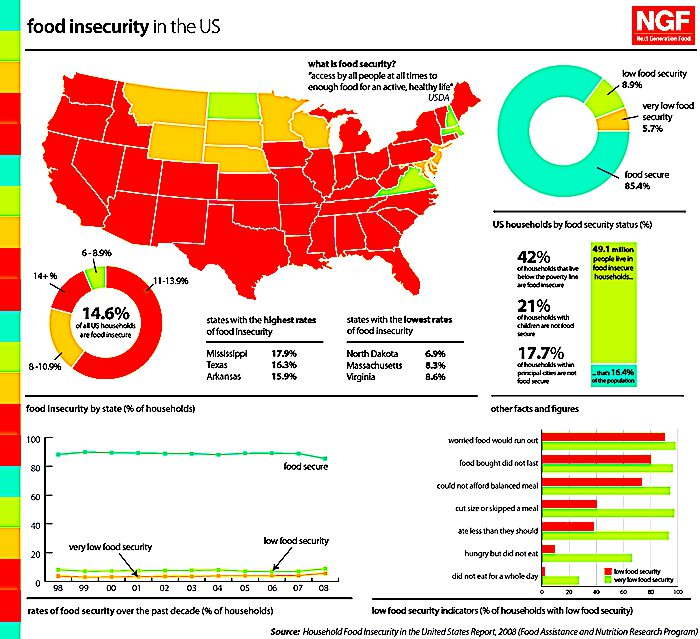
Food insecurity and hunger in the United States of America affects millions of Americans, including some who are middle class, or who are in households where all adults are in work. The United States produces far more food than it needs for domestic consumption; however, hunger within the U.S. is primarily caused by some Americans having insufficient money to buy food for themselves or their families. Additional causes of hunger and food insecurity include neighborhood deprivation and agricultural policy.[1][2] Hunger is addressed by a mix of public and private food aid provision. Public interventions include changes to agricultural policy, the construction of supermarkets in underserved neighborhoods, investment in transportation infrastructure, and the development of community gardens.[3][4][5][6] Private aid can be provided through examples such as food pantries, soup kitchens, food banks, and food rescue organizations.[7][8][9]
Hunger in America is a crisis 48 million people face hunger in the U.S.—including 14 million children. Hunger touches every U.S. community, including yours’
The scale of the current global hunger and malnutrition crisis is enormous. A staggering 266 million people are already facing crisis levels of hunger or worse, according to the Global Report on Food Crises. The conflict in the Middle East is deepening this food crisis to an alarming degree, with the World Food Programme warning of record numbers of acute hunger if it continues. In 2025, two simultaneous famines were confirmed in parts of Gaza and Sudan – a devastating first this century. Many food crises involve multiple overlapping issues that are building year on year. What are the main causes of the global food crisis?
- ConflictA total 70 percent of acutely food-insecure people live in fragile or conflict-affected countries. Now, conflict and instability in the Middle East pose a major threat to millions of people’s food security, both in countries within the region and those beyond as the the war inflicts severe disruption to global humanitarian supply chains. Conflict in East, Central and West Africa as well as in the Caribbean, southern Asia and Eastern Europe are also fuelling hunger. Conflict disrupts food production, forces people from their homes and sources of income, and often hinders humanitarian access to people in most need.
- Climate The climate crisis is one of the leading causes of the steep rise in global hunger. Climate shocks destroy lives, crops and livelihoods, and undermine people’s ability to feed themselves. Hunger will spiral out of control if the world fails to take immediate climate action.
- Economy Sluggish global growth and economic stressors, linked to slow pandemic recovery and fallout from the war in Ukraine, continue to affect low and middle-income countries. This limits investment in social protection programmes, at a time when food prices remain at crisis levels.
- Displacementn
- Forcibly displaced people face specific vulnerabilities in relation to food insecurity including limited access to employment, livelihoods, food and shelter, and reliance on dwindling humanitarian assistance.
In a capitalist society, the motive behind the production of food is not to feed people; housing is not made to give them shelter; clothing is not made to keep them warm; and health care is not offered primarily to keep people healthy. All of these things, which are and should be viewed as basic rights, are nothing other than commodities—to be bought and sold—from which to make a profit. If a profit cannot be made, usually due to overproduction in relation to the market, the commodity is considered useless by the capitalists and destroyed. So to answer the question, “Why is there hunger in the richest country in the world?” Capitalism.What is needed to solve hunger? An economy that consciously plans to satisfy the human need for food as well as for housing, education and health care. What we need brothers and sisters, is socialism. — Food and capitalism: a crisis of waste and destruction
US Food Banks Under Strain as Trump Policies Drive Up Costs
Video: Why El Niño 2026 has scientists worried | The Global Story
Video:It’s Time I Sound The Alarm…Natural disasters around the world appear to be increasing in frequency and severity, and now with a super El Niño gearing up for its most energetic phase, what’s coming may be more than any of us could bargain for. Geophysicist Stefan Burns reports…
Video: Chris Hedges: What Will the Iran War Do to the Global Economy? (W/ John Mearsheimer)
Video: “Godzilla” El Niño = Crashing Antarctic Sea Ice?
Video: Class 2: “The Investor’s View” by UC Berkeley Professor Reich
Doomsnday Glacier AI Overview: As of late September 2026, the most critical updates on Antarctica’s Thwaites Glacier (the “Doomsday Glacier”) center on the imminent disintegration of its eastern ice shelf, a surge in rare ice quakes, and alarming new historical data on polar ice loss.
1. The Imminent Collapse of the Eastern Ice Shelf The floating Thwaites Eastern Ice Shelf, which covers roughly 1,500 square kilometers (about the size of Greater London) and acts as a massive “cork” holding back the land-based glacier, is fracturing rapidly and is expected to detach. [1, 2, 3]
- The “Shattering Windscreen” Phenomenon: Recent satellite imagery shows spreading cracks near the shelf’s anchoring points. Scientists compare the current structural decay to a shattered car windshield that is barely holding together. [1]
- Vanishing Resistance: The ice shelf has drifted off its stabilizing undersea ridge. Because this natural brake is failing, the speed of the glacier’s upstream flow into the ocean has already surged by approximately 33% since 2020. While the detachment of the floating shelf won’t immediately raise sea levels, it “clears the runway” for the 2-kilometer-thick land glacier behind it to slide into the ocean much faster. [1, 2, 3]
Climate Crisis Made Rare East Coast Nor’easter Up to 50 Times More Likely Massive rainfall, heavy flooding, high wind speeds, and tall ocean waves were all reported due to the storm.
Florida Homeowners Are Paying the Price of a Broken Disaster System Floridians pay some of the country’s highest property insurance premiums, averaging $4,200 to $5,700 a year.
Alito Recusal in Landmark Climate Case Called ‘Bare Minimum’ Given Big Oil Tactics Oil companies warned Alito that if the Supreme Court didn’t exempt them from state climate lawsuits, it could adversely affect his personal investments.
Danish government capitulates to Trump over Greenland Since Trump returned to the White House, the United States has been relentlessly trying to take over Greenland through a mix of blackmail, purchase offers, and threats of punitive tariffs and military intervention. After several months of secret negotiations between Danish, Greenlandic, and US authorities, Trump announced on social media on 19 September that they had now reached an agreement on a new security pact. This agreement was subsequently signed by all parties with great fanfare in New York. But if you look past the diplomatic smokescreen, the ugly reality becomes apparent. In reality, this agreement is an imperialist horse-trade in which an entire country, over the heads of its people, has been de facto handed over to the greatest imperialist power on the planet. This shows that the Danish ruling class views Greenland in exactly the same way as the American ruling class does: as a commodity. The Danish ruling class is therefore just as cynical as the American imperialists.
The Real Reason Why Trump Invited China’s President Xi To Washington Trump’s summit with President Xi Jinping led to few results, but symbolized how the US lost its trade war. Now top US corporations want to get into the Chinese market. That’s why Trump invited them to his White House dinner. … When Trump started his second term in 2025, he drastically escalated the conflict into the equivalent of a nuclear trade war. In April of that year, the White House’s economic war against China peaked, with eye-watering blanket tariffs of 145%.
China defended itself against Trump’s commercial assault, hitting back with reciprocal tariffs at the same level, while also restricting the export of rare earth elements — without which many US companies simply cannot function (especially those in Silicon Valley and the military-industrial complex).
Khanna Says Trump Impeachment About “Setting a Standard” of Accountability Polling demonstrates that a majority of Americans approve of the idea of impeaching the president.
Trump’s Dismantling of Student Loan Aid Is Crashing Down on Debtors This Week
Meet the 22 California Billionaires Opposing Prop. 40 The rich Californians who’ve spent the most to fight a ballot proposal to tax billionaires have seen their personal wealth increase by over 64% in the last 20 months. On Nov. 3, 2026, California voters will vote on Proposition 40, a one-time 5% levy on the net worth of billionaires who were California residents on Jan. 1, 2026. Ninety percent of the revenue would fund healthcare programs, with the remainder set aside for food assistance and education. A small segment of the state’s 200 plus billionaires has stepped up to oppose Proposition 40, contributing millions to opposition groups and vocally speaking out against the one-time fee. In a brief report, “California’s Billionaire Wealth Surge: Meet the 22 California Billionaires Opposing Prop 40 Billionaire Wealth Tax,” we identified 22 California billionaires who are active funders and outspoken opponents of Proposition 40. Together they have given over $150 million to oppose the initiative — with more rolling in every day. These 22 include a prince, several private jet-flying chums of Jeffrey Epstein and a bunch of crypto and tech bros designing the AI future for the rest of us.
The Real Reason Why Trump Invited China’s President Xi To Washington
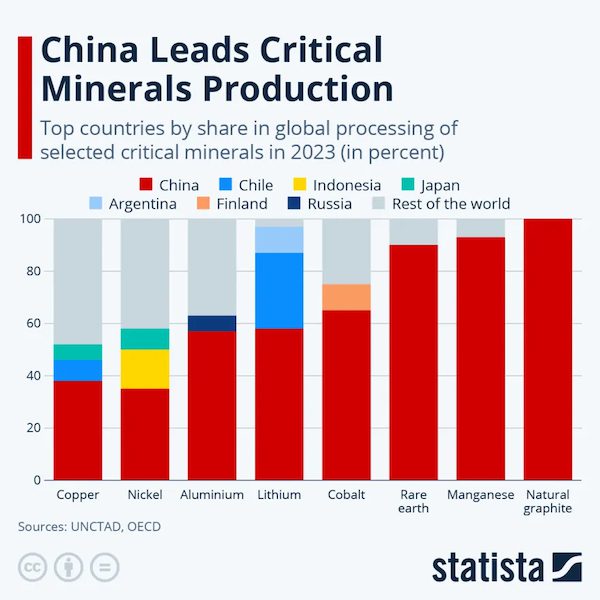
Trump’s summit with President Xi Jinping led to few results, but symbolized how the US lost its trade war. Now top US corporations want to get into the Chinese market. That’s why Trump invited them to his White House dinner. … When Trump started his second term in 2025, he drastically escalated the conflict into the equivalent of a nuclear trade war. In April of that year, the White House’s economic war against China peaked, with eye-watering blanket tariffs of 145%.
China defended itself against Trump’s commercial assault, hitting back with reciprocal tariffs at the same level, while also restricting the export of rare earth elements — without which many US companies simply cannot function (especially those in Silicon Valley and the military-industrial complex).
Khanna Says Trump Impeachment About “Setting a Standard” of Accountability Polling demonstrates that a majority of Americans approve of the idea of impeaching the president.
Trump’s Dismantling of Student Loan Aid Is Crashing Down on Debtors This Week
Mental Health Is Worker HealthIt is clear from occupational health research that work does impact mental health, and this impact should compel politicians to explicitly legislate and develop regulations to protect workers’ mental health.