
Daily News 09/20
Daily News 09/20
Daily News Archives Since June 2026
Hundreds of thousands attend Iran’s biggest government-organized rally since the war began

Blowback: How the Iran war may change the world Experts from across Brookings analyze the long-term implications of the war and provide policy recommendations for decisionmakers in Washington and around the world. More than 100 days have passed since the United States and Israel launched ambitious joint military operations against the Islamic Republic of Iran. The initial strikes killed Ayatollah Ali Khamenei, who had served as the Islamic Republic’s supreme leader for nearly 37 years, along with dozens of senior military and political officials. But the decapitation of Iran’s leadership did not collapse its regime, which has remained firmly in control and began retaliating almost immediately. Tehran’s missile and drone counterstrikes targeted Israel and the Gulf states, U.S. military bases, and maritime traffic in the Strait of Hormuz, blocking the strategic chokepoint through which 20% of the world’s oil and liquified natural gas supplies typically pass. However and whenever the conflict ends, the Iran war will have major implications for the evolving international security and economic order. For that reason, consistent with the Brookings Institution’s mission to advance global security and prosperity, we’ve challenged researchers and experts from across the organization to analyze the long-term implications of the war and provide policy recommendations for decisionmakers in Washington and around the world. Read From Our Experts
Video: Hundreds of thousands attend Iran’s biggest government-organized rally since the war began Hundreds of thousands of Iranians rallied Friday in a government-organized show of defiance after months of war, pledging their readiness to take up arms in the biggest such demonstration since the United States and Israel attacked in February. Iran’s government has sought to rally the people and stress national unity, even as the economy worsens under a U.S. naval blockade of Iranian ports and new U.S. sanctions. On Friday, it claimed another attack on a tanker in the Strait of Hormuz, a key waterway it has sought to control since the start of the war. Estimates varied of the number of people volunteering to receive limited military training and defend the country in an effort described as “Janfaday-e Iran,” or the “ones who sacrifice their lives for Iran.” They marched through downtown Tehran in combat uniform, carrying flags, as onlookers cheered.
Bond market troubles reveal impending crisisThe US government is having to pay increasing amounts of interest to borrow money. For the first time since 2007, interest on its 10-year debt has reached five percent. The crisis in the bond markets reflects the pressures arising from the Hormuz crisis, protectionism and the chaotic AI buildout. It is revealing all the contradictions in the world economy that is heading towards a crisis. In August, US Secretary to the Treasury Scott Bessent announced that he would buy back $6 billion of 10- and 20-year bonds in an effort to keep the interest rate (yield, as they call it) from rising further. Then he said he would double the amount. At that time, the rate stood at 4.85 percent, but it has risen further since. His efforts, in other words, failed. This shouldn’t surprise anyone, given that the US government issues $2.7 trillion worth of debt of various kinds every month.

Video: Kathleen Tyson and Michael Hudson:The Economy at the End of the World: The Mechanics of Financial Rupture
Trump administration sued over threat to deploy federal law enforcement at voting sitesCivil rights groups say plan will make people ‘afraid to vote’ and violates the Voting Rights Act
Money LaunderingMoney laundering is the processing of criminal proceeds to disguise their illegal origin. This process is of critical importance, as it enables the criminal to enjoy these profits without jeopardizing their source.
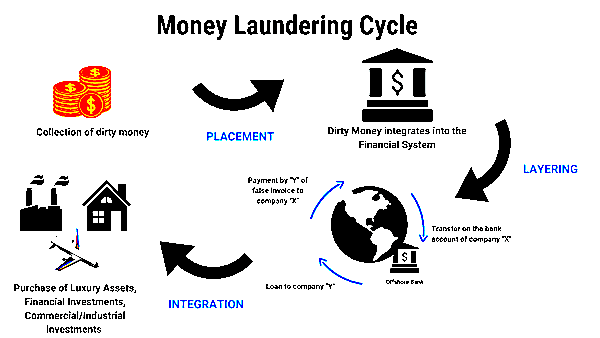
There is a consensus among U.S. Congressional Investigators, former bankers and international banking experts that U.S. and European banks launder between $500 billion and $1 trillion of dirty money each year, half of which is laundered by U.S. banks alone. As Senator Carl Levin summarizes the record: “Estimates are that $500 billion to $1 trillion of international criminal proceeds are moved internationally and deposited into bank accounts annually. It is estimated that half of that money comes to the United States”. . . U.S. Banks and The Dirty Money Empire Washington and the mass media have portrayed the U.S. as being in the forefront of the struggle against narco trafficking, drug laundering and political corruption: the image is of clean white hands fighting dirty money. The truth is exactly the opposite. U.S. banks have developed a highly elaborate set of policies for transferring illicit funds to the U.S., investing those funds in legitimate businesses or U.S. government bonds and legitimating them. — “Dirty Money”Foundation of US Growth and EmpireSize and Scope of Money Laundering by US Banks (2001)
War on Drugs: Murders ‘Drug Carrying’ FishermenTrump Admin Permanently Guts Law ‘Designed to Stop Criminals from Laundering Money’ After Push From Elon Musk, But Aids Drug Lords Laundering Drug Money:
Trump officials sending undocumented children to Texas sparks fears of mass deportationExclusive: Nearly 90% of children in federal custody being directed to GOP-controlled state that has unlicensed facilities and low legal representation rates
Video: Carl Sagan testifying before Congress in 1985 on climate change
Video: Professor Jeffrey Sachs: The Iran War Will Break America
Video: Scientists Warn Of Ocean Impact After Glaciers Lost Trillions Of Tons Of IceGreenland and Antarctica are cold, remote places that most of us will never visit, but they are important to Earth and the environment. Now scientists are issuing a dire warning that these places are melting away. A new report from Northumbria University in the UK says these polar places have lost nearly 12 trillion tons of ice since the 1970s, raising sea levels by three centimeters. Inside Edition Digital’s Mara Montalbano has more.
Video: Niño WarningHansen’s El Niño WarningIn this episode we examine James Hansen’s analysis of a developing El Niño against the backdrop of a rapidly warming planet. We discuss Hansen’s warning that global warming may be accelerating as Earth absorbs more energy, and that an El Niño occurring on top of this elevated heat could help drive exceptionally high global temperatures in the years ahead.
Video: This Winter Is About To Go Very Wrong For Millions In Europe
Video: This Super El Niño Could Be Hiding a Much Bigger Problem
Video: Scientists Didn’t Expect This: Earth Is Changing at Both Ends
Yale Environment 360: Overshoot: The World Is Hitting Point of No Return on Climate “Nature has so far balanced our abuse,” says Johan Rockström, a leading Earth systems scientist. “This is coming to an end.” With warming set to pass the critical 1.5-degree limit, scientists are warning that the world is on course to trigger tipping points that would lead to cascading consequences — from the melting of ice sheets to the death of the Amazon rainforest — that could not be reversed. The world is poised to overshoot the goal of limiting average global warming to 1.5 degrees Celsius, as for the first time, a three-year period, ending in 2025, has breached the threshold. And climate scientists are predicting devastating consequences, just as the world’s governments appear to have lost their appetite for tackling the emissions that are causing the warming. The 1.5-degree target was set at the Paris climate conference a decade ago, at the insistence of more vulnerable nations, to forestall severe weather impacts and potential runaway warming that could lead to exceeding irreversible planetary tipping points. But climate scientists say that 10 years of weak action since mean that nothing can now stop the target being breached. “Climate policy has failed. The 2015 landmark Paris agreement is dead,” says atmospheric chemist Robert Watson, a former chair of the U.N.’s arbiters of climate science, the Intergovernmental Panel on Climate Change (IPCC). Meanwhile, a picture of what lies ahead is becoming clearer. In particular, there is a growing fear that climate change in the future won’t, as it has until now, happen gradually. It will happen suddenly, as formerly stable planetary systems transgress tipping points — thresholds beyond which things cannot be put back together again.
Drone footage shows severe drought hitting river in Brazil
US wheat farmers navigate uncertainty amid drought and geopolitical chaosSome experts worry factors affecting wheat exports could push global food prices even higher than they are now