
Daily News 08/23
Daily News 08/23
Daily News Archives Since June 2026
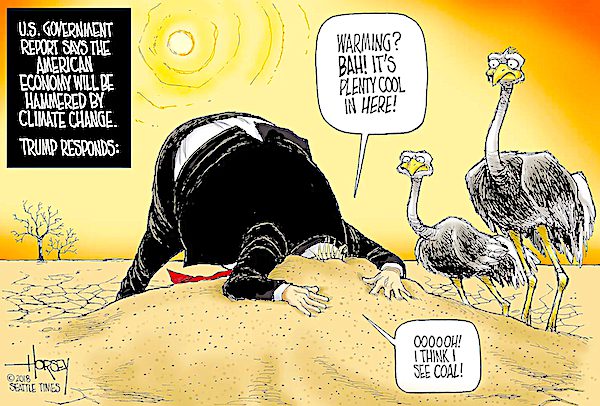
U.S. climate change report economy Trump denial coal
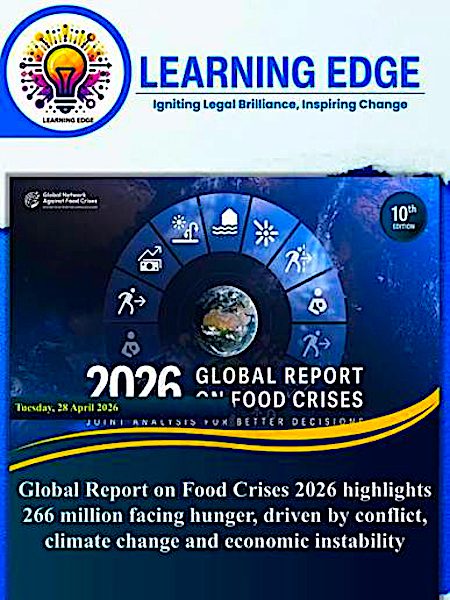
Learning Edge Global Report on Food Crises (GRFC) 2026
AI Overview: The global food and water crisis is driven by compounding pressures from severe climate shocks, geopolitical conflicts, and skyrocketing fertilizer and energy costs. Over 2.4 billion people currently live in water-stressed regions, and hundreds of millions face acute food insecurity due to distribution failures, depleted freshwater reserves, and restricted trade supply chains. Track live metrics and updates through the World Bank Food Security Update and the World Food Programme. —Global Food and Water Crisis
El Niño, Iran War and fertilizer shortages There are two prongs to JPMorgan’s predicted food deficits: a fertilizer shortage and a monumental weather event. And the Strait of Hormuz’s closure wasn’t just bad for gasoline prices. The strait also sees about a third of the world’s nitrogen fertilizer — an essential form of fertilizer for around half of the world’s crops. Nitrogen fertilizer shortages are a ticking time bomb. Because it’s needed during the early stages of crop growth, we could still be feeling the effects of a shortage as much as a year later. “Agriculture operates within a crop calendar that cannot be postponed, said Qu Dongyu, director-general of the Food and Agriculture Organization of the United Nations, in a news post on their website. “Fertilizers must be applied at specific moments in the crop cycle. If they do not arrive on time, yields are reduced, regardless of what happens later.” — JPMorgan warns a global food crisis could hit next year, and unlike oil, there’s no backup plan for fertilizer
Capitalists Support Global WarmingNew documents, obtained through the Freedom of Information Act by the National Security Archive and shared with DeSmog, detail industry’s attempts to loosen federal methane pollution reporting requirements while simultaneously urging the U.S. government to preserve the GHGRP. This is the EPA’s overarching emissions monitoring system, which offers public data informing policy decisions. The hollowing of emissions reporting rules could have major implications for helping the U.S. address the rapidly accelerating climate crisis, from the local to international level. “Oil and gas CEOs will always support weak rules they already comply with rather than no rules at all,” Edward Maibach, a climate change communication expert at George Mason University, said by email to DeSmog and the National Security Archive. “Supporting no rules at all would prove to everyone how untrustworthy they are.” — Inside the Struggle to Dismantle America’s Greenhouse Gas Data New documents detail industry efforts to roll back federal regulations on methane, the main component of natural gas.
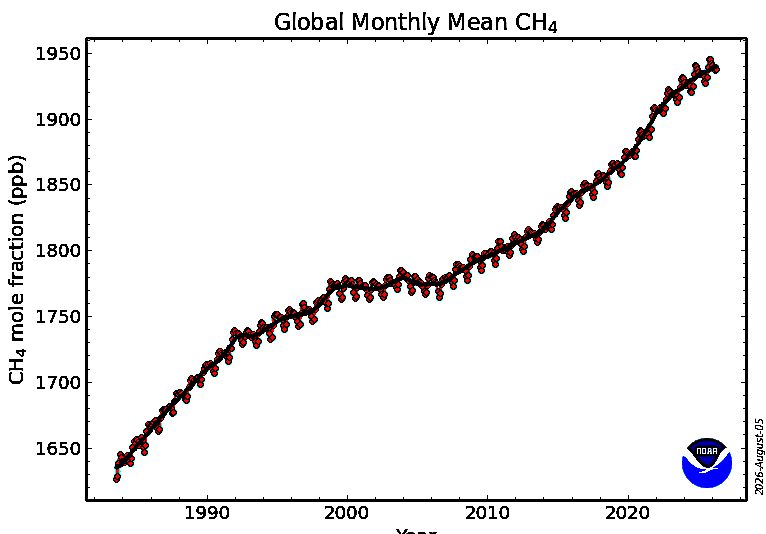
Methane is the primary contributor to the formation of ground-level ozone, a hazardous air pollutant and greenhouse gas, exposure to which causes 1 million premature deaths every year. Methane is also a powerful greenhouse gas. Over a 20-year period, it is 80 times more potent at warming than carbon dioxide. Methane has accounted for roughly 30 per cent of global warming since pre-industrial times and is proliferating faster than at any other time since record keeping began in the 1980s. In fact, according to data from the United States National Oceanic and Atmospheric Administration, even as carbon dioxideemissions decelerated during the pandemic-related lockdowns of 2020, — Methane emissions are driving climate change. Here’s how to reduce them.
Trends in Atmospheric Methane (CH4)
Scientists detect a sharp acceleration in global warmingGlobal warming appears to have shifted into a faster gear. After removing the effects of El Niño, volcanic eruptions, and solar cycles, researchers found that the planet has warmed at roughly 0.35°C per decade over the past ten years, compared with just under 0.2°C per decade from 1970 to 2015. The acceleration, which becomes visible around 2013 to 2015, appeared across five major global temperature datasets with more than 98% statistical certainty
Protecting our ‘most vital infrastructure’: Pushing back on desertification As heatwaves are turning deadlier, fires and disasters are razing cities — and rising seas are erasing territories — one environmental crisis remains dangerously overlooked: the degradation of the land beneath our feet. Desertification, the phenomenon whereby fertile land becomes unproductive and desert-like, is spreading at alarming rates across the globe due to rising temperatures, droughts and deforestation.
GOODBYE FAMILY FARMS AND HELLO AGRIBUSINESS: THE STORY OF HOW AGRICULTURAL POLICY IS DESTROYING THE FAMILY FARM AND THE ENVIRONMENT I. INTRODUCTION If the saying is true that you are what you eat, maybe it is time to think about what we are actually eating. When you stroll through any grocery store, you see aisles upon aisles full of packaged and processed foods that are representative of today’s industrial food system.’ The foods stocked in these aisles are diverse, affordable, and fully satiate our appetites. 2 If, however, we take a closer look at the health, vitality, sustainability, and policy behind the food we purchase, what we discover will be surprising.3 Where does our food come from? Surprisingly, it does not come from a peaceful, idyllic farm in Nebraska because United States farm production has shifted to larger operations, usually referred to as agribusinesses.4 Agribusinesses are industrial farming operations that are much bigger and produce significantly more products than smaller, family farms.5 Currently, “approximately ninety-eight percent of America’s food supply is produced by agribusinesses.” 6 The growth of these large-scale farms has led to an alarming decrease in the number of family farms.7 The loss of the family farm and the increase in industrial farms has created a plethora of environmental concerns.8 The current agricultural industry relies on the use of large amounts of water, fertilizers, pesticides, and fossil fuels.9 The use of these resources has severe environmental impacts on water, land, wildlife, and air.10 The shift to larger farms has also induced a transition to larger livestock operations.” I Most Americans today purchase their meat from agricultural operations that raise animals in intensive confinement, such as “several thousand pigs or tens of thousands of chickens per barn.”12 These operations are referred to as either animal feeding operations (AFOs) or concentrated animal feeding operations (CAFOs).13 AFOs and CAFOs are problematic because “[t]hey emphasize high volume and profit with little regard for human health, food safety, the environment, humane treatment of animals or the rural economy.”14 The greatest problem with raising so many aniagribusinesses.” 6 The growth of these large-scale farms has led to an alarming decrease in the number of family farms.7 The loss of the family farm and the increase in industrial farms has created a plethora of environmental concerns.8 The current agricultural industry relies on the use of large amounts of water, fertilizers, pesticides, and fossil fuels.9 The use of these resources has severe environmental impacts on water, land, wildlife, and air.10 The shift to larger farms has also induced a transition to larger livestock operations.” I Most Americans today purchase their meat from agricultural operations that raise animals in intensive confinement, such as “several thousand pigs or tens of thousands of chickens per barn.”12 These operations are referred to as either animal feeding operations (AFOs) or concentrated animal feeding operations (CAFOs).13 AFOs and CAFOs are problematic because “[t]hey emphasize high volume and profit with little regard for human health, food safety, the environment, humane treatment of animals or the rural economy.”14
Warning: Factory Farms are a Threat to Life! Factory farming significantly pollutes air, water, and land, contributing to climate change through emissions like methane and nitrous oxide, which are more potent than carbon dioxide. It is linked to respiratory illnesses and reduced quality of life for communities near operations, and pollutes waterways with nutrients and pathogens from animal waste. In the U.S., the agricultural sector accounts for a significant portion of the nation’s greenhouse gas emissions, and animal agriculture is a major source of these pollutants. Factory Farms Cause Pandemics! NIH National Library of Medicine Primary Pendemic Prevention: Over the last few decades, hundreds of human pathogens have emerged at a rate unprecedented in human history. Emerged from where? Mostly from animals. The AIDS virus is blamed on the butchering of primates in the African bushmeat trade, we created mad cow disease when we turned cows into carnivores and cannibals, and SARS and COVID-19 have been traced back to the exotic wild animal trade. Our last pandemic, swine flu in 2009, arose not from some backwater wet market in Asia, however. It was largely made-in-the-USA on pig production operations in the United States. In this new Age of Emerging Diseases, there are now billions of animals overcrowded and intensively confined in filthy factory farms for viruses to incubate and mutate within. Today’s industrial farming practices have given viruses billions more spins at pandemic roulette. How can we stop the emergence of pandemic viruses in the first place? Whenever possible, treat the cause. The largest and oldest association of public health professionals in the world, the American Public Health Association, has called for a moratorium on factory farming for nearly two decades. Indeed, factory farms are a public health menace. In addition to discontinuing the intensive confinement practices of animal agriculture, we should continue to research, develop, and invest in innovative plant-based and cultivated meat technologies to move away from raising billions of feathered and curly-tailed test tubes for viruses with pandemic potential to mutate within.
Video: ‘Strongest El Niño of the century’ is coming. Should we be scared? | BBC NewsIn this video…
- 0:00 – 1:15 Intro
- 1:16 – 3:37 What is an El Nino?
- 3:38 – 4:14 Should we be worried?
- 4:15 – 7:32 What are the impacts?
- 7:33 – 8:04 Did El Nino make 2026 hotter?
- 8:05 – 9:03 Will it be as strong as 1877?
- 9:03 – 10:09 Is El Nino linked to climate change?
Video: 20 Trillion Gallons of Water Are Headed for California
Video: Wolff Responds: “Say Goodbye To The American Dream” Dated August 19, 2026
Video: EXPLAINED: Are Drought & Wildfire DESTROYING Germany’s Economy?
The ‘War on/for Drugs’: USA And Israel Put Drug Cartel-Linked US Citizen In Power In Colombia
House Democrat Suggests DSA Members in Congress Shouldn’t Get Security Clearances
Climate Change and the U.S. Economic Future The effects of climate change will be different across the country, with some of the worst impacts falling on already-disadvantaged regions. … ECONOMIC IMPACT. Understanding the damages due to climate change at both national and local scales is important for assessing the benefits that will accrue from any policy that limits climate change, as well as for informing policies to adapt. As the global mean temperature rises, various sectors will be adversely impacted, such as agriculture, crime, coastal storms, energy, human mortality and labor. Taken together, these effects could cost roughly 0.7 percent of GDP for every 1°F increase in temperature on average. Overall, climate change will harm the U.S. economy, even with modest amounts of warming. The U.S. economy would stand to lose between about 1 percent to 4 percent of GDP annually by the end of the century through effects to mortality, labor and the energy sector alone under a high emissions scenario. These effects, moreover, will not be felt equally. The poorest third of counties in the United States are projected to experience damages costing between 2 and 20 percent of county income under a high emissions scenario—much greater than the losses in the richest third, and substantially widening the income gap between rich and poor parts of the country. This will saddle those areas that may already have fewer resources to adapt with larger damages. Southern, coastal states will experience substantial, detrimental effects from climate change, including higher temperatures and exposure to enhanced coastal damages from storms and sea level rise. Colder, more northerly parts of the United States will experience fewer damaging effects from climate change. Though the impacts of climate change will be felt in some places more than others, no part of the country will be insulated. A hurricane in Florida or Texas still requires federal assistance, and a Midwestern heatwave with negative effects on agriculture will affect food prices in other parts of the country.
Vampire Planet: How Capitalism Chokes Los AngelesIt’s a balmy evening in San Pedro, California. I’m standing on the outskirts of a Little League ballpark atop a knoll, overlooking the arching Vincent St. Thomas Bridge. Below, a sea of shipping containers is stacked high like Lego blocks, forming mini-skyscrapers along the dusky horizon. Together, the Ports of LA and Long Beach handle 40% of all containerized imports into the United States. It’s a mammoth, sprawling complex spanning 24 square miles. It’s also one of the largest sources of pollution in the LA area.
How the Climate Crisis Is Becoming a Financial Stability Risk As rivers run dry across Germany, Romania, and Hungary, and wildfires in Europe have caused an estimated US$3.6 billion in economic losses in just two months, bankers are analysing the potential economic impact from the degradation of ecosystems.
Without action wildfires in Europe will increase 39% even in best-case climate scenario, study finds
The existential crisis of European capitalism
Teaching History at the Death of History My subject, history, is in terminal decline. A.I. finally killed it, but it has been sick since the late twentieth century. The demise of a reading public, disinformation, fake news, and political spin fatally weakened it. Undergraduates have fled the history major, and PhDs can’t find jobs teaching or writing it.[1] It’s curtains for my vocation. The timing is sadly ironic. We need history. Without it, we’re adrift in a sea of events without precedent, cause, or meaning. Cut off from the past, we become prey to those who would use history for nefarious purposes: those who deny precedents by saying “nothing like this has ever happened before.”[2] Those who start wars by claiming that its victims “have no history” independent of the aggressors.[3]Those who twist a deadly riot into a “day of love.”[4] Orwell was right when he warned that he who controls the past controls the future. We ignore his words at our peril. There’s tragedy in a society killing the thing that could save it.