
Daily News 07/20
Daily News 07/20
Daily News Archives Since I Got Blocked From Facebook (Israel Asked Facebook to Censor Iran War Content, Documents Show)
Pax Americana and It’s Ecocidal Drive for Profits! Pax Americana

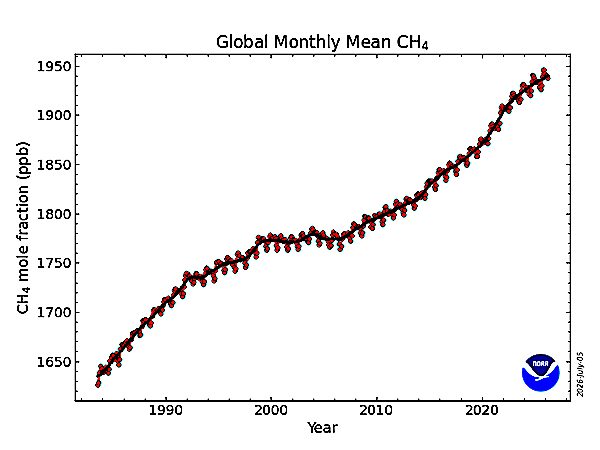
Trends in Atmospheric Methane (CH4) March 2026:1937.86 ppb March 2025: 1933.60 ppb
Why do we compare methane to carbon dioxide over a 100-year timeframe? Are we underrating the importance of methane emissions?This greenhouse gas is short-lived but has far greater heat-trapping potential than CO2. The more concerned we are about global warming over the next 10 or 20 years, the more emphasis we have to put on cutting methane emissions. Methane is a colorless, odorless gas that’s produced both by nature (such as in wetlands when plants decompose underwater) and in industry (for example, natural gas is mostly made of methane). It is widely regarded as the second most important greenhouse gas, after carbon dioxide (CO2). However, methane is about 200 times less abundant in the atmosphere and lasts there for only about a decade on average—while CO2 can last for centuries. To put it another way: methane does its damage quickly but soon fades away, while CO2 traps a smaller amount of heat consistently, decade after decade. The trouble is that the answer changes depending on how far in the future you look. Let’s say a factory releases a ton of methane and a ton of CO2 into the atmosphere today. The methane immediately begins to trap a lot of heat—at least 100 times as much as the CO2. But the methane starts to break down and leave the atmosphere relatively quickly. As more time goes by, and as more of that original ton of methane disappears, the steady warming effect of the CO2 slowly closes the gap. Over 20 years, the methane would trap about 80 times as much heat as the CO2. Over 100 years, that original ton of methane would trap about 28 times as much heat as the ton of CO2. …
Video: Scientists Just Issued a Terrifying Warning About Antarctica’s Doomsday Glacier
From Fracking to Data Centers—Hamster Wheels and That Same Old Song and DanceThe current system is set up to protect industry, capitalism, and the profits of a few, not the people and environment.
Latest Precipitation Models Still Seem to Underestimate Risk as ‘1,000-Year’ Rain Events Pummel TexasThe Nueces River of South Texas flowed at twice the rate of Niagara Falls last week during the region’s second flood disaster in two years.
Wprld Health Organization: Wildfires Wildfires are increasing around the globe in frequency, severity and duration, heightening the need to understand the health effects of wildfire exposure. The risk of wildfires grows in extremely dry conditions, such as drought, heat waves and during high winds. Wildfire smoke is a mixture of hazardous air pollutants, such PM2.5, NO2, ozone, aromatic hydrocarbons, or lead. In addition to contaminating the air with toxic pollutants, wildfires also simultaneously impact the climate by releasing large quantities of carbon dioxide and other greenhouse gases into the atmosphere. With climate change leading to warmer temperatures and drier conditions and the increasing urbanization of rural areas, the fire season is starting earlier and ending later. Wildfire events are getting more extreme in terms of acres burned, duration and intensity, and they can disrupt transportation, communications, water supply, and power and gas services.
Majority of US voters link extreme weather to climate crisis, study finds Top Democrat says findings show public ‘way ahead of the politicians’ as Trump dismisses global heating as ‘hoax’
How Trump and his administration have mired the US in multiple crises From manufactured election insecurity to an outbreak of ‘explosive’ diarrhea, Americans are bearing the brunt of harmful policies
The Serious Health risks Posed by Wildfire Smoke WHAT IS CONTAINED IN WILDFIRE SMOKE? More toxic than normal air pollution, wildfire smoke can linger in the air for weeks and travel thousands of miles. Wildfires can burn not only vegetation but also vehicles and buildings as well as their contents. Along with particles of soil and biological materials, wildfire smoke often contains traces of chemicals, metals, plastics and other synthetic materials. WHAT ARE THE KNOWN HEALTH EFFECTS? In laboratory experiments, wildfire smoke causes more inflammation and tissue damage than air pollution, said Kent Pinkerton, co-director of the Center for Health and the Environment at the University of California, Davis.Studies have linked wildfire smoke with higher rates of heart attacks, strokes, and cardiac arrests, increases in emergency room visits for asthma, weakened immune defenses and poorer survival rates after surgery. A 2023 study in Maryland, identified a spike in heart and lung illnesses that was associated with wildfire smoke originating up to 2,100 miles (3,380 km) away. Wildfires also have been linked with eye and skin problems..
Climate Crisis-Denying Trump Threatens Canada With New Tariffs Over Wildfire Smoke
Mamdani Says He Is Examining Whether His Government Can Arrest Netanyahu During NYC Visit
As the 1% *ncluding Trum and the Trump Family Profit from War Industry Profits: The Pentagon Is Stealing From the Working Poor to Pay for War and Enrich ContractorsThe average US taxpayer in 2025 had over $4,000 taken out of their paychecks to fund the Pentagon; in the coming years, that amount is set to rise as Congress considers a $1.5 trillion war budget for 2027.
What the Nation Can Learn From Seattle’s Fresh Bucks ProgramAfter more than a decade of implementation, Fresh Bucks offers evidence that targeted investments in healthy food can improve food security, increase fruit and vegetable consumption, and help reduce nutritional inequality.
Mirror, Mirror 2024: A Portrait of the Failing U.S. Health System Abstract
- Goal: Compare health system performance in 10 countries, including the United States, to glean insights for U.S. improvement.
- Methods: Analysis of 70 health system performance measures in five areas: access to care, care process, administrative efficiency, equity, and health outcomes.
- Key Findings: The top three countries are Australia, the Netherlands, and the United Kingdom, although differences in overall performance between most countries are relatively small. The only clear outlier is the U.S., where health system performance is dramatically lower.
- Conclusion: The U.S. continues to be in a class by itself in the underperformance of its health care sector. While the other nine countries differ in the details of their systems and in their performance on domains, unlike the U.S., they all have found a way to meet their residents’ most basic health care needs, including universal coverage.