
After Malcolm X and Martin Luther Kings Were Assassinated, Potential Blck Liberation Leaders Became Black Democratc Party Politicians — The Result? Resgregation of the United States!
After Malcolm X and Martin Luther Kings Were Assassinated, Potential Blck Liberation Leaders Became Black Democratc Party Politicians — The Result? Resgregation of the United States!
“In the end, we will remember not the words of our enemies, but the silence of our friends.” — MLK
Navigating Back to Segregation
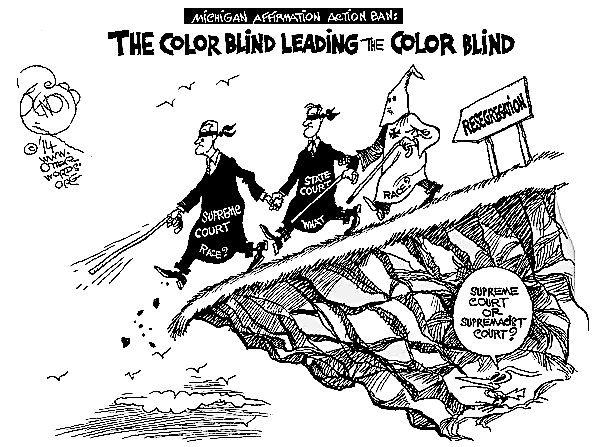
To combat the rise of the Civil Right Movement, the “war on poverty” was first launched in 1964 along with the concept of “Black Politicians”. Malcolm X described this process in his Jan. 7, 1965 speech The Prospects for Freedom, at the Militant Labor Forum, in New York City (For complete an audio of the speech go here.): “They have a new gimmick every year. They’re going to take one of their boys, black boys, and put him in the cabinet so he can walk around Washington with a cigar. Fire on one end and fool on the other end. And because his immediate personal problem will have been solved he will be the one to tell our people: ‘Look how much progress we’re making. I’m in Washington, D.C., I can have tea in the White House. I’m your spokesman, I’m your leader.’ While our people are still living in Harlem in the slums. Still receiving the worst form of education. But how many sitting here right now feel that they could [laughs] truly identify with a struggle that was designed to eliminate the basic causes that create the conditions that exist? Not very many. They can jive, but when it comes to identifying yourself with a struggle that is not endorsed by the power structure, that is not acceptable, that the ground rules are not laid down by the society in which you live, in which you are struggling against, you can’t identify with that, you step back. It’s easy to become a satellite today without even realizing it. This country can seduce God. Yes, it has that seductive power of economic dollarism. You can cut out colonialism, imperialism and all other kind of ism, but it’s hard for you to cut that dollarism. When they drop those dollars on you, you’ll fold though.” After the assassination of Martin Luther King and the subsequent rebellions in the inner cities protesting his assassination, the Democratic Party’s “war on poverty” started laying dollars on any potential Black leaders and grooming Black Candidates.John Lewis, formally of SNCC, became enlightened, he ignored the Black Panthers and saw the Democratic Party, symbolized by a jackass, as his party. Most of what W.E. B. Dubois described as the “talented tenth” were bought off by this process. The more radical concepts that Martin Luther King and Malcolm X had developed at the time of their deaths disappeared from the scene. No one took up where they left off. The governmental policy, directed towards the ‘leaders’ of the civil rights movement, of the carrot (dollarism) and the stick (assassinations) had proven to be successful. — The Government Assassinated Malcolm X and Martin Luther King
Resegregation United States: AI: Key Areas of Resegregation
- Public Education: Despite the 1954 Brown v. Board of Education ruling, many schools have resegregated to levels seen in the 1960s. As of 2022–2023, approximately 83% of Black students and 82% of Latino students attended majority non-white schools. The number of schools with 90–100% students of color has more than doubled since 1988.
- Housing and Neighborhoods: Residential segregation remains persistent, often driven by legacies of redlining. When students attend the closest neighborhood school, this residential isolation directly translates into school segregation.
- Labor Markets: Recent trends show stagnant or worsening occupational segregation, with visible backlash against diversity, equity, and inclusion (DEI) initiatives in workplaces and higher education.
- Socioeconomic Disparities: Differences in wealth and resources between communities continue to create “separate and unequal” environments.
- Systemic Barriers: The lack of federal enforcement and sustained public pressure has allowed de facto segregation to strengthen.
- Impact
- This resegregation has significant consequences for access to quality healthcare, educational outcomes, and wealth accumulation, often perpetuating the achievement gap and fostering social mistrust
Contributing Factors
- Legal Rulings: Supreme Court decisions in the 1990s and early 2000s (e.g., Oklahoma City v. Dowell) allowed districts to terminate desegregation orders, leading to a rapid dismantling of integration plans..
PolitiFact VA: Public schools are more segregated now than in the late 1960s The United States is backtracking on integrating public schools, according to Rep. Bobby Scott (D-Va). “Yesterday marks the 68th anniversary of the Supreme Court’s historic Brown v. Board of Education decision, which struck down the unlawful school segregation,” Scott said during a May 18 meeting of the House Education & Labor Committee. “Yet, we know public schools are now as segregated by race and class as they were in the 1960s.”
Gentrification, Segregation, and Discrimination in the American Urban System American Neighborhoods are Segregated by Income. What Does That Mean for the Future of Income Inequality, Neighborhoods, and Children? Both income inequality and residential segregation have increased, leaving some neighborhoods trapped in poverty. As the saying goes, there are three things that matter in real estate: Location, location, location. Some neighborhoods offer more amenities than others—more trees, calmer streets, better schools, easier access to employment or transit. It’s no surprise that neighborhoods with greater amenities become more expensive places to live. This puts the cost of housing in high-amenity neighborhoods out of reach for some households, leading to segregation by income. Income segregation in America is not static, however. As Minneapolis Fed Assistant Director for Inequality Research and Monetary Advisor Alessandra Fogli and her co-authors observe in a recent Institute working paper, it has been increasing for 40 years. Wage inequality has also grown over this period. Fogli and her co-authors want to understand if there is a connection between these two trends. Does existing residential segregation cause further income inequality, which in turn feeds further segregation? The answer matters because research shows that neighborhood amenities can influence more than quality of life. The connection between the neighborhood where a child grows up and their future economic outcomes has been documented by economists Raj Chetty and Nathaniel Hendren (a former and current Institute advisor, respectively). By comparing the outcomes of siblings who were different ages when their family moved to a better-off neighborhood, Chetty and Hendren show that each additional year spent living in the better-off neighborhood increases average income in adulthood.
School Desegregation by Redrawing District Noundaries
Abstract
Schools in the United States remain heavily segregated by race and income. Previous work demonstrates districts can promote group diversity within their schools with policies like redrawing attendance zones. Yet, the promise of such policies in many areas is limited by the fact that most school segregation occurs between school districts, and not between schools in the same district. I adapt Markov Chain Monte Carlo algorithms from legislative redistricting to redraw school district boundaries that decrease segregation while maintaining desirable criteria like distance to school and using only existing school facilities. Focusing on New Jersey, where the segregation of Black and Hispanic students from White and Asian students is among the worst in the country, I demonstrate that redrawing school districts could reduce more than 40% of existing segregation in the median New Jersey county, compared to less than 5% for redrawing attendance zones alone. Finally, I show how my proposed methodology can be applied to as few as two districts to reduce segregation in proposed consolidations, when small districts are merged into a larger district.