
Ignorance Is Strength! The Orwellian Nightmare of American Public Schools!
Ignorance Is Strength! The Orwellian Nightmare of American Public Schools!
The constant bi-partisan attacks on public education is Owellian. They have led to a decline in letteracy, deline is teaching historical facts, and, and since the 1980s the resegregation of the United States Public Schools! Plus the higher coasts of a college education, has led to a usury stdent loan system, which has put graduate is a state of permanent debt!
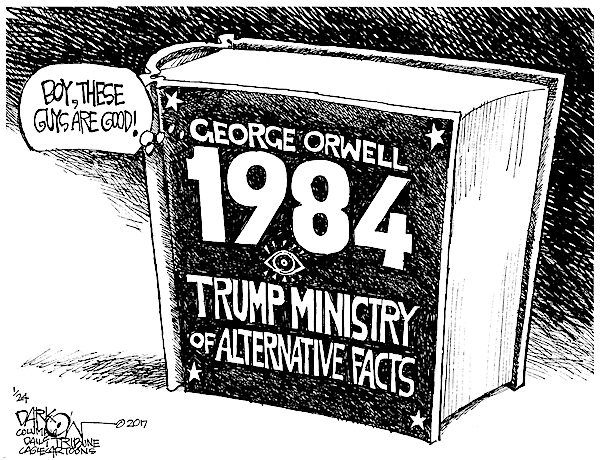
1984 Trump Ministry of Altenative Facts
Just One Effect of Student Debt:
Student Debt: An Overlooked Barrier to Increasing Teacher Diversity Black and Latinx students’ disparate experiences with student loan debt compared with their white counterparts may affect their choice to enter or stay in the teaching profession.
Introduction and summary
There is clear evidence that a diverse teaching workforce is beneficial for all students—and particularly for students of color.1 Studies show that Black students perform better on standardized tests, have improved attendance, and are suspended less frequently when they have at least one same-race teacher.2 Black teachers are more likely to recommend high-achieving Black students for talented and gifted programs, virtually eliminating the gap in access to these programs.3 And there is evidence that same-race role models—in this instance, teachers of color—inspire minority students.4 While much of the research on teacher diversity has looked at the importance of Black teachers for Black students, partly due to low sample sizes of Latinx teachers and other teachers of color, there may be similar effects for other students of color. The research on teacher diversity is critically important considering that in the 2015-2016 school year, 51 percent of U.S. students identified as nonwhite, and those percentages will grow in the coming years.5
The Orwellian Nightmare of American Public Schools.
George Orwell once wrote that English public schools ingrained a sense of snobbery (or haughty arrogance) and not much else. He also pointed out that national education didn’t properly teach its student charges to be freethinkers and dissenters.
Although the English public school system would be considered private from the American perspective, Orwell’s assessment holds true in America as well, at least for its failure to teach students to think for themselves and to equip them with much more than threadbare literacy and an overconfidence built upon deeply classist ideologies.
Unfortunately, to criticize the American public school infrastructure is to trespass a serious taboo. We claim to be the best public education system in the world, but many American public schools are in shambles, especially after four years of gutted federal spending by a megalomaniacal Secretary of Education who further hobbled an already crippled establishment for personal gain.
For many people who are lucky enough to go to college or university, the eye-opening experience of taking a civics course can be a startling in-depth look at national history that was pitifully glossed over in the previous 12 years. This isn’t to cast aspersions at teachers. They thanklessly toil in an environment that undervalues (and under compensates) them as much as it undervalues the students. But unless we can criticize and challenge the old rotten beams upon which modern education is built, no positive change can be made.
America’s chief product is children. Just shy of 3.8 million children were born in 2018 in America. Those children eventually become students in the world’s first experimental society based on self-rule. That the dissent of republican and democratic colonists led to “independency” and forcibly breaking from monarchical sovereignty to form an autonomic society based on free thought is the jewel in our national crown. The founding mothers and fathers were by nature dissenters and nonconformists and their examples are rightly to be praised. What better principles to teach each new crop of young ones, if not how to think like the founders? It would certainly instill and ingrain an appreciation for the real foundational ideas and discussions in our national history.
But American public education has trivialized these heroes of dissent by incorporating their lives and histories into tawdry patriotic holidays and myths when it bothers to mention them at all. For many, the founders are no more than faces on currency and statues in monuments. Students rarely get exposed to how each of these free thinking individuals directly contributed to the formation of our nation let alone how they thought and interacted with their peers and what drove them to break away from the mad Hanoverian King. Ask any tenth grader who Thomas Paine was and the answer won’t so much surprise you as dismay you. If students don’t know, then adults (who also managed to come through the educational system) don’t know either.
America’s birthright comes directly from Enlightenment ideals. It’s not even questioned. But our students aren’t invested in why that is important. We cannot hope to establish a true sense of ownership and participation in civil discourse and debate in young people when the years where such investments ought to be made are instead filled with exercises in obedience, rule following, pointless and excessive school work, homework and continuous testing.
We plumb the depths of futile nationalism by teaching absurd patriotic allegiance poems but we fail to keen the easily sharpened young intelligences with self-led exploration of the world, use of the scientific method, civic debate, open discussion about why things are the way they are, use of logic and, above all, dissent
OAH Issues Statement Condemning Federal Censorship
The American Historical Association (AHA) and the Organization of American Historians (OAH) condemn recent efforts to censor historical content on federal government websites, at many public museums, and across a wide swath of government resources that include essential data. New policies that purge words, phrases, and content that some officials deem suspect on ideological grounds constitute a systemic campaign to distort, manipulate, and erase significant parts of the historical record. Recent directives insidiously prioritize narrow ideology over historical research, historical accuracy, and the actual experiences of Americans. As the institution chartered by the US Congress for “the promotion of historical studies” and “in the interest of American history, and of history in America,” the American Historical Association must speak out when the nation’s leadership wreaks havoc with that history. So, too, must the OAH, as the organization committed to promoting “excellence in the scholarship, teaching, and presentation of American history.” It is bad enough to forget the past; it is even worse to intentionally deny the public access to what we remember, have documented, and have expended public resources to disseminate.
At this writing, the full range of historical distortions and deletions is yet to be discerned. Federal entities and institutions subject to federal oversight and funding are hastily implementing revisions to their resources in an attempt to comply with the “Dear Colleague” letter issued by the Department of Education’s Office of Civil Rights and executive orders such as “Defending Women from Gender Ideology Extremism and Restoring Biological Truth to the Federal Government.”
These changes range from scrubbing words and acronyms from websites to papering over interpretive panels in museums. Some alterations, such as those related to topics like the Tuskegee Airmen and the internment of Japanese Americans during World War II, have been hurriedly reversed in response to public outcry. Others remain. The scrubbing of words and acronyms from the Stonewall National Monument webpage, for instance, distorts the site’s history by denying the roles of transgender and queer people in movements for rights and liberation. This distortion of history renders the past unrecognizable to the people who lived it and useless to those who seek to learn from the past. I
t remains unclear whether federal agencies are preserving the original versions of these materials for future reference or research. Articles written by historians for the National Park Service, for example, have been altered, and in some instances deleted, because they examine history with references to gender or sexuality. These revisions were made without the authors’ knowledge or consent, and without public acknowledgment that the original articles had been revised. The AHA’s Statement on Standards of Professional Conduct is clear: “Honoring the historical record also means leaving a clear trail for subsequent historians to follow. Any changes to a primary source or published secondary work, whether digital or print, should be noted.”
Words matter. Precision matters. Context matters. Expertise matters. Democracy matters. We can neither deny what happened nor invent things that did not happen. Recent executive orders and other federal directives alter the public record in ways that are contrary to historical evidence. They result in deceitful narratives of the past that violate the professional standards of our discipline. When government entities, or scholars themselves, censor the use of particular words, they in effect censor historical evidence. Censorship and distortion erase people and institutions from history.
The AHA’s Statement on Standards of Professional Conduct makes clear that historians can neither misrepresent their sources nor omit evidence because it “runs counter” to their interpretations. The OAH and AHA condemn the rejection of these professional standards. Classifying collective historical scholarship as “toxic indoctrination” or “discriminatory equity ideology” dismisses the knowledge generated by the deep research of generations of historians. It violates the training, expertise, and purposes of historians as well as their responsibility to public audiences.
Our professional ethics require that “all historians believe in honoring the integrity of the historical record.” We expect our nation’s leadership to adhere to this same basic standard and we will continue to monitor, protest, and place in the historical record any censorship of American historical facts.
For the Last 155 Years, the United States has Followed a Policy of Ignorance is Strength! Trump is a Representative of that Slogan!
In George Orwell’s 1984, “Ignorance is strength” is a key slogan that underscores the Party’s method of control and manipulation. It suggests that keeping the population uninformed and accepting of illogical propaganda helps maintain the Party’s power. This slogan is part of a triad of contradictory statements: “War is peace,” “Freedom is slavery,” and “Ignorance is strength,” which are intended to confuse and control the population. — AI Overview
The Literacy Crisis in America to studies by the National Literacy Institute in 2024, 21% of American adults are illiterate.
The National Assessment for Adult Literacy found the literacy rate for American adults in 1870 was a gross total of 11.5% from census data. In 1979, that number was at 0.4%.
With most early estimations for literacy and education heading into the 21st century pointing towards an even further downwards trend of illiteracy, we are seeing the highest rates in 155 years.
National Literacy Instituete Literacy Statistics 2005-2023 (Where we are Now)
- On average, 79% of U.S. adults nationwide are literate in 2024
- 21% of adults in the US are illiterate in 2024.
- 54% of adults have a literacy below a 6th-grade level (20% are below 5th-grade level).
- Low levels of literacy costs the US up to 2.2 trillion per year.
- 34% of adults lacking literacy proficiency were born outside the US
- Massachusetts was the state with the highest rate of child literacy.
- New Mexico was the state with the lowest child literacy rate.
- New Hampshire was the state with the highest percentage of adults considered literate.
The state with the lowest adult literacy rate was California. On average, 79% of U.S. adults nationwide are literate in 2024.
Where does the US rank in literacy?: The US ranks 36th in global literacy according to some sources, while others place it around 14th among industrialized nations in recent studies. Despite these conflicting rankings, a significant portion of the US population has low literacy, with some estimates suggesting over half of adults read below a sixth-grade level. This highlights a gap between overall literacy rates and the number of adults with low proficiency.
Blacks Minority Children are Not Getting an Equal Education
School resegregation is the rapid trend since the 1980s of America’s schools becoming increasingly segregated by race and ethnicity, with more than a third of students attending schools where three-quarters or more of the student body is of a single race or ethnicity, returning to 1960s levels of segregation. Key drivers include the lifting of court-ordered desegregation plans and the rapid growth of charter schools, which, in some cases, have exacerbated segregation. This trend concentrates minority students in higher-poverty schools, leading to unequal learning opportunities and hindering the potential for social integration.
The constant bi-partisan attacks on public education is Owellian. They have led to a decline in letteracy, deline is teaching historical facts, and, and since the 1980s the resegregation of the United States Public Schools! Plus the higher coasts of a college education, has led to a usury stdent loan system, which has put graduate is a state of permanent debt!
Just One Effect of Student Debt: Student Debt: An Overlooked Barrier to Increasing Teacher Diversity Black and Latinx students’ disparate experiences with student loan debt compared with their white counterparts may affect their choice to enter or stay in the teaching profession.
Introduction and summary
There is clear evidence that a diverse teaching workforce is beneficial for all students—and particularly for students of color.1 Studies show that Black students perform better on standardized tests, have improved attendance, and are suspended less frequently when they have at least one same-race teacher.2 Black teachers are more likely to recommend high-achieving Black students for talented and gifted programs, virtually eliminating the gap in access to these programs.3 And there is evidence that same-race role models—in this instance, teachers of color—inspire minority students.4 While much of the research on teacher diversity has looked at the importance of Black teachers for Black students, partly due to low sample sizes of Latinx teachers and other teachers of color, there may be similar effects for other students of color. The research on teacher diversity is critically important considering that in the 2015-2016 school year, 51 percent of U.S. students identified as nonwhite, and those percentages will grow in the coming years.5
The Orwellian Nightmare of American Public Schools.
George Orwell once wrote that English public schools ingrained a sense of snobbery (or haughty arrogance) and not much else. He also pointed out that national education didn’t properly teach its student charges to be freethinkers and dissenters.
Although the English public school system would be considered private from the American perspective, Orwell’s assessment holds true in America as well, at least for its failure to teach students to think for themselves and to equip them with much more than threadbare literacy and an overconfidence built upon deeply classist ideologies.
Unfortunately, to criticize the American public school infrastructure is to trespass a serious taboo. We claim to be the best public education system in the world, but many American public schools are in shambles, especially after four years of gutted federal spending by a megalomaniacal Secretary of Education who further hobbled an already crippled establishment for personal gain.
For many people who are lucky enough to go to college or university, the eye-opening experience of taking a civics course can be a startling in-depth look at national history that was pitifully glossed over in the previous 12 years. This isn’t to cast aspersions at teachers. They thanklessly toil in an environment that undervalues (and under compensates) them as much as it undervalues the students. But unless we can criticize and challenge the old rotten beams upon which modern education is built, no positive change can be made.
America’s chief product is children. Just shy of 3.8 million children were born in 2018 in America. Those children eventually become students in the world’s first experimental society based on self-rule. That the dissent of republican and democratic colonists led to “independency” and forcibly breaking from monarchical sovereignty to form an autonomic society based on free thought is the jewel in our national crown. The founding mothers and fathers were by nature dissenters and nonconformists and their examples are rightly to be praised. What better principles to teach each new crop of young ones, if not how to think like the founders? It would certainly instill and ingrain an appreciation for the real foundational ideas and discussions in our national history.
But American public education has trivialized these heroes of dissent by incorporating their lives and histories into tawdry patriotic holidays and myths when it bothers to mention them at all. For many, the founders are no more than faces on currency and statues in monuments. Students rarely get exposed to how each of these free thinking individuals directly contributed to the formation of our nation let alone how they thought and interacted with their peers and what drove them to break away from the mad Hanoverian King. Ask any tenth grader who Thomas Paine was and the answer won’t so much surprise you as dismay you. If students don’t know, then adults (who also managed to come through the educational system) don’t know either.
America’s birthright comes directly from Enlightenment ideals. It’s not even questioned. But our students aren’t invested in why that is important. We cannot hope to establish a true sense of ownership and participation in civil discourse and debate in young people when the years where such investments ought to be made are instead filled with exercises in obedience, rule following, pointless and excessive school work, homework and continuous testing.
We plumb the depths of futile nationalism by teaching absurd patriotic allegiance poems but we fail to keen the easily sharpened young intelligences with self-led exploration of the world, use of the scientific method, civic debate, open discussion about why things are the way they are, use of logic and, above all, dissent
OAH Issues Statement Condemning Federal Censorship
The American Historical Association (AHA) and the Organization of American Historians (OAH) condemn recent efforts to censor historical content on federal government websites, at many public museums, and across a wide swath of government resources that include essential data. New policies that purge words, phrases, and content that some officials deem suspect on ideological grounds constitute a systemic campaign to distort, manipulate, and erase significant parts of the historical record. Recent directives insidiously prioritize narrow ideology over historical research, historical accuracy, and the actual experiences of Americans. As the institution chartered by the US Congress for “the promotion of historical studies” and “in the interest of American history, and of history in America,” the American Historical Association must speak out when the nation’s leadership wreaks havoc with that history. So, too, must the OAH, as the organization committed to promoting “excellence in the scholarship, teaching, and presentation of American history.” It is bad enough to forget the past; it is even worse to intentionally deny the public access to what we remember, have documented, and have expended public resources to disseminate.
At this writing, the full range of historical distortions and deletions is yet to be discerned. Federal entities and institutions subject to federal oversight and funding are hastily implementing revisions to their resources in an attempt to comply with the “Dear Colleague” letter issued by the Department of Education’s Office of Civil Rights and executive orders such as “Defending Women from Gender Ideology Extremism and Restoring Biological Truth to the Federal Government.” These changes range from scrubbing words and acronyms from websites to papering over interpretive panels in museums.
Some alterations, such as those related to topics like the Tuskegee Airmen and the internment of Japanese Americans during World War II, have been hurriedly reversed in response to public outcry. Others remain. The scrubbing of words and acronyms from the Stonewall National Monument webpage, for instance, distorts the site’s history by denying the roles of transgender and queer people in movements for rights and liberation. This distortion of history renders the past unrecognizable to the people who lived it and useless to those who seek to learn from the past.
It remains unclear whether federal agencies are preserving the original versions of these materials for future reference or research. Articles written by historians for the National Park Service, for example, have been altered, and in some instances deleted, because they examine history with references to gender or sexuality. These revisions were made without the authors’ knowledge or consent, and without public acknowledgment that the original articles had been revised.
The AHA’s Statement on Standards of Professional Conduct is clear: “Honoring the historical record also means leaving a clear trail for subsequent historians to follow. Any changes to a primary source or published secondary work, whether digital or print, should be noted.”
Words matter. Precision matters. Context matters. Expertise matters. Democracy matters. We can neither deny what happened nor invent things that did not happen. Recent executive orders and other federal directives alter the public record in ways that are contrary to historical evidence. They result in deceitful narratives of the past that violate the professional standards of our discipline. When government entities, or scholars themselves, censor the use of particular words, they in effect censor historical evidence. Censorship and distortion erase people and institutions from history.
The AHA’s Statement on Standards of Professional Conduct makes clear that historians can neither misrepresent their sources nor omit evidence because it “runs counter” to their interpretations. The OAH and AHA condemn the rejection of these professional standards. Classifying collective historical scholarship as “toxic indoctrination” or “discriminatory equity ideology” dismisses the knowledge generated by the deep research of generations of historians. It violates the training, expertise, and purposes of historians as well as their responsibility to public audiences.
Our professional ethics require that “all historians believe in honoring the integrity of the historical record.” We expect our nation’s leadership to adhere to this same basic standard and we will continue to monitor, protest, and place in the historical record any censorship of American historical facts.
For the Last 155 Years, the United States has Followed a Policy of Ignorance is Strength! Trump is a Representative of that Slogan!
In George Orwell’s 1984, “Ignorance is strength” is a key slogan that underscores the Party’s method of control and manipulation. It suggests that keeping the population uninformed and accepting of illogical propaganda helps maintain the Party’s power. This slogan is part of a triad of contradictory statements: “War is peace,” “Freedom is slavery,” and “Ignorance is strength,” which are intended to confuse and control the population. — AI Overview
The Literacy Crisis in America to studies by the National Literacy Institute in 2024, 21% of American adults are illiterate.
The National Assessment for Adult Literacy found the literacy rate for American adults in 1870 was a gross total of 11.5% from census data. In 1979, that number was at 0.4%.
With most early estimations for literacy and education heading into the 21st century pointing towards an even further downwards trend of illiteracy, we are seeing the highest rates in 155 years.
National Literacy Instituete Literacy Statistics 2005-2023 (Where we are Now)
- On average, 79% of U.S. adults nationwide are literate in 2024
- 21% of adults in the US are illiterate in 2024.
- 54% of adults have a literacy below a 6th-grade level (20% are below 5th-grade level).
- Low levels of literacy costs the US up to 2.2 trillion per year.
- 34% of adults lacking literacy proficiency were born outside the US
- Massachusetts was the state with the highest rate of child literacy.
- New Mexico was the state with the lowest child literacy rate.
- New Hampshire was the state with the highest percentage of adults considered literate.
The state with the lowest adult literacy rate was California. On average, 79% of U.S. adults nationwide are literate in 2024.
Where does the US rank in literacy?: The US ranks 36th in global literacy according to some sources, while others place it around 14th among industrialized nations in recent studies. Despite these conflicting rankings, a significant portion of the US population has low literacy, with some estimates suggesting over half of adults read below a sixth-grade level. This highlights a gap between overall literacy rates and the number of adults with low proficiency.
Blacks Minority Children are Not Getting an Equal Education
School Resgegration: School resegregation is the rapid trend since the 1980s of America’s schools becoming increasingly segregated by race and ethnicity, with more than a third of students attending schools where three-quarters or more of the student body is of a single race or ethnicity, returning to 1960s levels of segregation. Key drivers include the lifting of court-ordered desegregation plans and the rapid growth of charter schools, which, in some cases, have exacerbated segregation. This trend concentrates minority students in higher-poverty schools, leading to unequal learning opportunities and hindering the potential for social integration.