
Warning: Factory Farms are a Threat to Life!
Warning: Factory Farms are a Threat to Life!
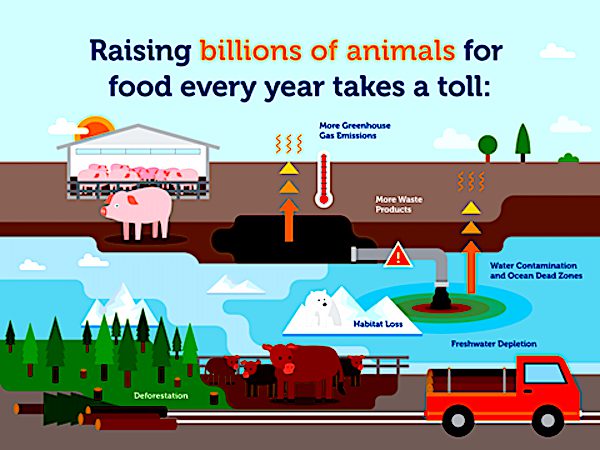
AI Overview: Factory farming significantly pollutes air, water, and land, contributing to climate change through emissions like methane and nitrous oxide, which are more potent than carbon dioxide. It is linked to respiratory illnesses and reduced quality of life for communities near operations, and pollutes waterways with nutrients and pathogens from animal waste. In the U.S., the agricultural sector accounts for a significant portion of the nation’s greenhouse gas emissions, and animal agriculture is a major source of these pollutants.
Factory Farms Cause Pandemics! NIH National Library of Medicine Primary Pendemic Prevention: Over the last few decades, hundreds of human pathogens have emerged at a rate unprecedented in human history. Emerged from where? Mostly from animals. The AIDS virus is blamed on the butchering of primates in the African bushmeat trade, we created mad cow disease when we turned cows into carnivores and cannibals, and SARS and COVID-19 have been traced back to the exotic wild animal trade. Our last pandemic, swine flu in 2009, arose not from some backwater wet market in Asia, however. It was largely made-in-the-USA on pig production operations in the United States. In this new Age of Emerging Diseases, there are now billions of animals overcrowded and intensively confined in filthy factory farms for viruses to incubate and mutate within.
Today’s industrial farming practices have given viruses billions more spins at pandemic roulette. How can we stop the emergence of pandemic viruses in the first place? Whenever possible, treat the cause. The largest and oldest association of public health professionals in the world, the American Public Health Association, has called for a moratorium on factory farming for nearly two decades. Indeed, factory farms are a public health menace.
In addition to discontinuing the intensive confinement practices of animal agriculture, we should continue to research, develop, and invest in innovative plant-based and cultivated meat technologies to move away from raising billions of feathered and curly-tailed test tubes for viruses with pandemic potential to mutate within.
The Massive Impact Of Factory Farming On Our Environment We often worry about the climate footprint of the planet’s 7.8 billion people, but overlook the environmental consequences of sustaining 70 billion farm animals each year. Industrial animal agriculture is one of the leading contributors to climate change, responsible for about 15.4 percent of global greenhouse gas emissions. That’s nearly as much as the entire global transportation sector — that means that the meat and dairy industry emits almost as much heat-trapping gas as all the planes, trains, and cars in the world combined. No matter how you cut it, raising, feeding, and then killing billions of animals is an inefficient and resource-intensive way to feed our growing global population. After all, it takes about 10 pounds of grain to produce just 1 pound of meat, according to the United Nations Convention to Combat Desertification.
We often worry about the climate footprint of the planet’s 7.8 billion people, but overlook the environmental consequences of sustaining 70 billion farm animals each year. However, just like human beings, animals require tons of food to do basic things like gain weight, develop muscle mass, and stay alive. Ultimately, factory farming exacerbates deforestation and water scarcity, and is responsible for methane and nitrous oxide pollution that is detrimental to the planet.
Land Use and Deforestation Forests, which are crucial for sustaining life on Earth, are being destroyed at unprecedented rates. These ecosystems store huge quantities of carbon in their biomass, making them critical carbon sinks. However, they are frequently cleared in order to grow feed or to pave grazing land for livestock, posing a grave threat to our climate. In the US, roughly 260 million acres of forested land have been cleared to make room for crops, and more than 67 percent of these crops — predominantly soy, corn and grains — become food for livestock, rather than food that is consumed directly by people. Despite taking up so much land, meat and dairy products provide only 36 percent of the calorie content of the US food supply.
This deforestation crisis is global. In Brazil’s Amazon Rainforest, for example, animal agriculture is linked to 75 percent of historic deforestation, as ranchers burn forests in order to convert them to pasture for beef and leather. Similarly, between 2000 and 2014, the Congo Basin — the world’s second largest rainforest — lost an area of forest the size of Bangladesh due to slash-and-burn deforestation.
While growing food is always going to require significant amounts of land and water, animal agriculture is particularly inefficient. Farm animals consume a third of the planet’s grain production and a third of the planet’s ice-free land. If people primarily consumed plants, agriculture would be responsible for significantly less deforestation.
Freshwater Use In addition to polluting the air and degrading natural lands, industrial animal agriculture uses an enormous amount of freshwater. In the US, it is responsible for 55 percent of water consumption, whereas domestic water use — the water used in households — makes up only 5 percent. Globally, factory farming uses 16 percent of the planet’s freshwater.
Here’s another way to think about it: it takes about 2,500 gallons of water to produce one pound of beef, while most fruit, vegetables, and plant-based proteins require between 15 to a couple hundred gallons of water per pound to produce. Similarly, producing cow milk requires twice as much water as producing almond milk — and almond milk is the most water-intensive plant-based milk alternative. When you scale those differences, it makes an enormous impact. By eating plant-based, it’s estimated that one person can save approximately 219,000 gallons of water per year.
Environmentally-conscious individuals may try to reduce their water usage by doing things like taking shorter showers, but dietary choices have a much larger impact. If you switch from a hamburger to a veggie burger one time, you’ll save as much water as not showering for two entire months. As the world’s water supply continues to shrink, conserving our freshwater is critical.
2026 Update:Factory Farms and Cancer New Links:
Communities Near Concentrated Animal Feeding Operations Have Higher Cancer RatesAir and water pollution from the massive farms may be playing a role, according to a new study. animal feeding operations, or CAFOs, in California, Texas and Iowa suffer from higher rates of cancer, suggesting that the air and water pollution from the massive farms may be playing a role, according to a new study. The study, published in the journal Environmental Research, comes just weeks after a years-long report in Iowa found the state’s agricultural chemicals and CAFO pollution are, in part, behind its rising cancer rate. In the new study, Yale University researchers examined the rates of all cancers over the past 20 years in Texas, California and Iowa counties along with the density of CAFOs in the counties. High exposure counties were defined as those in the top 25% of CAFO density for their state. The researchers found rates for all types of cancers were 4% higher in highly exposed California counties, and 8% higher in highly exposed Iowa and Texas counties when compared to counties with lower CAFO density.
Iowa cancer rates surge — farm chemicals are a key risk, new report findsIowans are suffering from higher rates of more than a dozen types of cancers linked to pesticides and pollutants than the rest of the country, with researchers saying the risk of pesticide exposure alone may rival that of smoking, according to a new report. Iowa has the second-highest rate of cancer in the nation and is only one of three states where cancer is rising, according to the National Institutes of Health. For many types of cancer, the state’s numbers dwarf national averages. For example, Iowa’s rate of prostate cancer is 129 people per 100,000, compared to the US average of 116 people. The state’s breast cancer rate is 137 people per 100,000, compared to the US average of 131 people.