
Why the Monntgomery Boycott Was Successful
Why the Monntgomery Boycott Was Successful
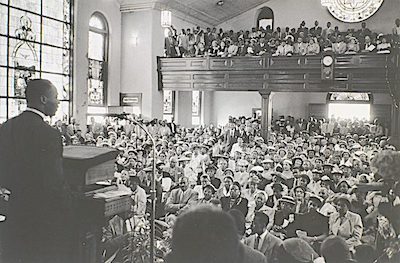
Martin Luther King Speaks at Mongomery Improvement Assocication (MIA) Meeting (Video)
Why the Monntgomery Boycott Was Successful
- It had mass support and its strength developed from the unity of the Black masses to boycott the buses.
- In order to sustain the boycott, the MIA had organized an alternative transportation system, which gave the masses the ability to get to work for over a year, something that was crucial to the success of the boycott.
- The democratically organized Montgomery Improvement Association had regular weekly mass meetings of thousands to decide the strategy and tactics of the movement.
- The power of independent mass action, independent of the politicians, was demonstrated by the Montgomery Bus Boycott.
- In order to sustain the boycott, the MIA had organized an alternative transportation system.
In order to sustain the boycott, the MIA had organized an alternative transportation system, which gave the masses the ability to get to work for over a year, something that was crucial to the success of the boycott. In his San Francisco speech1 King explained this system and decision. He stated:
“One of the first practical problems that the ex-bus riders [had experienced] is that in finding some way to get around the city. The first thing that we decided to do was to use a taxi, and they had agreed to transport the people for just ten cents, the same as the buses. Then the police commission stopped this by warning the taxis that they must charge a minimum of forty-five cents a person. Then we immediately got on the job and organized a volunteer car pool. And almost overnight over three hundred cars were out on the streets of Montgomery. [applause] They were out on the streets of Montgomery carrying the people to and from work from the various pickup and dispatch stations. It worked amazingly well. Even Commissioner Sellers had to admit in a White Citizens Council meeting that the system worked with ‘military precision.’ [applause] It has continued to grow and it is still growing. Since that time we have added more than twenty station wagons to the car pool and they’re working every day, all day, transporting the people. It has been an expensive project. Started out about two thousand dollars or more a week, but now it runs more than five thousand dollars a week. We have been able to carry on because of the contributions coming from the local community and nationally, from the great contributions that have come from friends of good will all over the nation and all over the world. [applause]”2
I had the good fortune to meet E.D. Nixon a few hours prior to the December 13, 1965 Militant Labor Forum. From my conversations, prior to this forum, with E.D. Nixon and Clifton DeBerry, (1964 Presidential candidate of the Socialist Workers Party), who helped organize the 1956 “Stationwagons for Montgomery Campaign,” it became clear to me, that the success of this transportation system was made possible by the Korean War GI’s, who used their experience in the army’s “motor pools” specifically and the army generally, to perform the maintenance of the automobiles and become the hard core of the drivers that sustained this transportation system for a year. It was also widely known, in Montgomery, that these men also had the ability and the willingness to defend themselves if the KKK attacked the transportation system. Due to the wide knowledge of this fact , and the world attention that the Boycott had achieved, the racists were unable to disrupt the car pool, that “worked with military precision.”
The democratically organized Montgomery Improvement Association had regular weekly mass meetings of thousands to decide the strategy and tactics of the movement.
The democratically organized Montgomery Improvement Association had regular weekly mass meetings of thousands to decide the strategy and tactics of the movement. The people in the struggle had control and the final say – not the leaders from on high. This helped to insured the power of the movement, for the masses saw the MIA as their organization and were committed by their votes to implement their decisions. The tactics of both mass civil disobedience (the boycott) and self defense by the MIA was key to the success of the struggle.
The power of independent mass action, independent of the politicians, was demonstrated by the Montgomery Bus Boycott. This is the power that ispired and garnered support from throughout the nation and the world.
To gain more mass appeal for the Poor Peoples Campaign In 1967 Martin Luther King said:
“There is nothing but a lack of social vision to prevent us from paying an adequate wage to every American citizen whether he be a hospital worker, laundry worker, maid, or day laborer. There is nothing except shortsightedness to prevent us from guaranteeing an annual minimum-and livable-income for every American family.There is nothing, except a tragic death wish, to prevent us from reordering our priorities.… The coalition of an energized section of labor, Negroes, unemployed, and welfare recipients may be the source of power that reshapes economic relationships and ushers in a breakthrough to a new level of social reform. The total elimination of poverty, now a practical responsibility, the reality of equality in race relations and other profound structural changes in society may well begin here.” 8
The Montgomery Bus Boycott led by the Montgomery Improvement Association was an example of such a coalition and it remains, to this day, one of the best models for victorious struggle in the history of working people in the United States.The Montgomery Bus Boycott was a demonstration of the power of Black Unity in action independent of and not reliant to the Democratic and Republican Parties.
For an in depth artical on the Boycott go to: